
Configuring Actions within Applications
Configure actions within each application in the workflow
Note: While this documentation references onboarding workflows for illustration, the process of configuring actions applies identically to offboarding.
Configuring Actions
Actions define the specific tasks each application performs during onboarding. For example, adding a user to Slack, assigning a GitHub license, or creating a Jira account.
This guide covers action groups, the process to add actions, configure their parameters, and manage them after configuration.
Action Groups and Classifications
Actions in Zluri are organized into groups based on their purpose. Understanding these groups helps select the right actions for the workflow.
Choose Action Menu
A Choose Action menu is a drop-down displaying actions grouped by type, such as Add, Update, Manual, Zluri Action, Delete, Custom Actions, and Others.
Example: Add Group
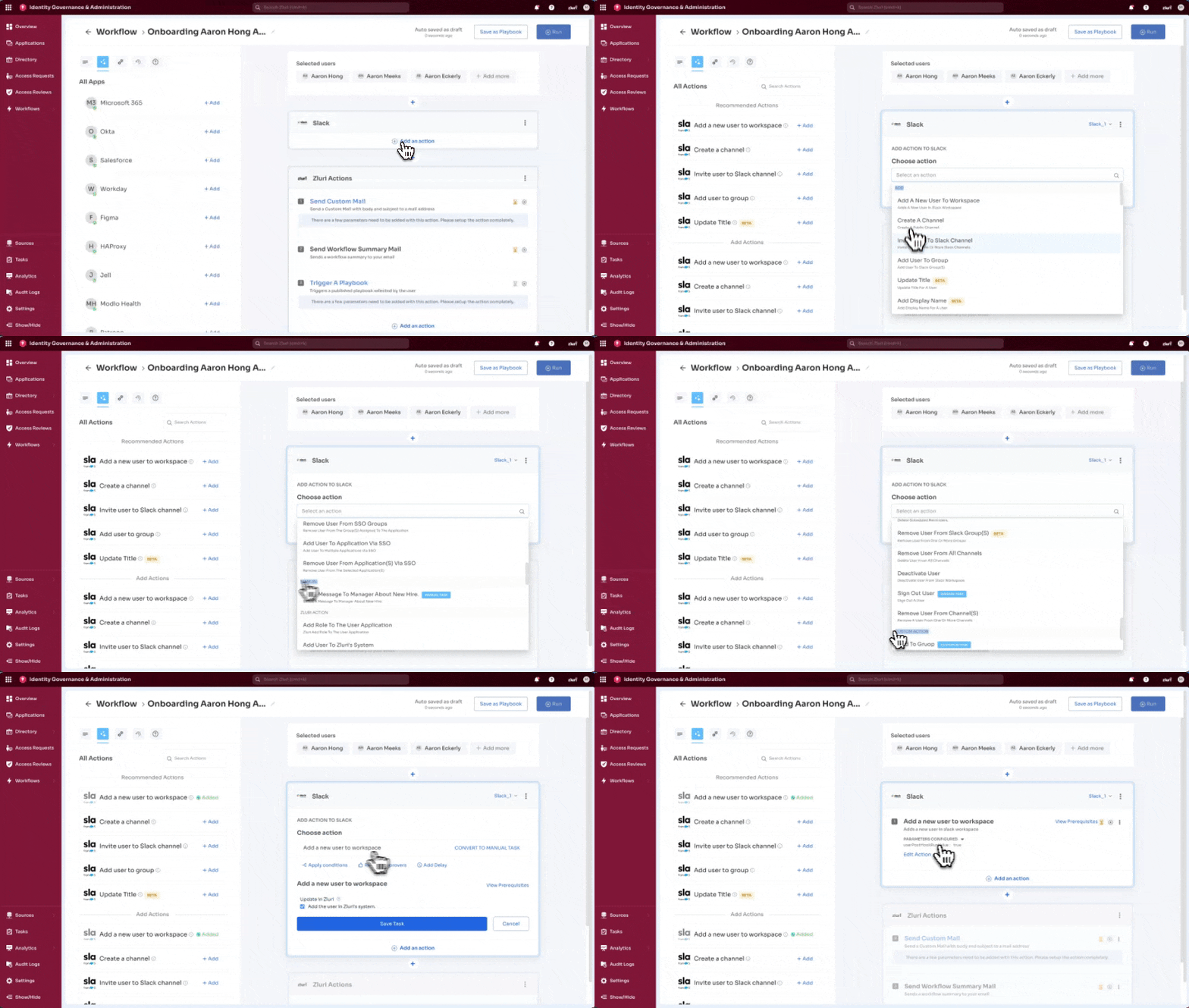
An Admin selecting an action from the 'Add' group in the Slack app block will see actions performing operations related to adding users to the application.
The Admin then chooses an action named ‘Add a New User To A Workspace’. Upon configuration, this action will add a new user to the Slack workspace. Similarly, other actions can be added to an app block.
Example: Delete Group
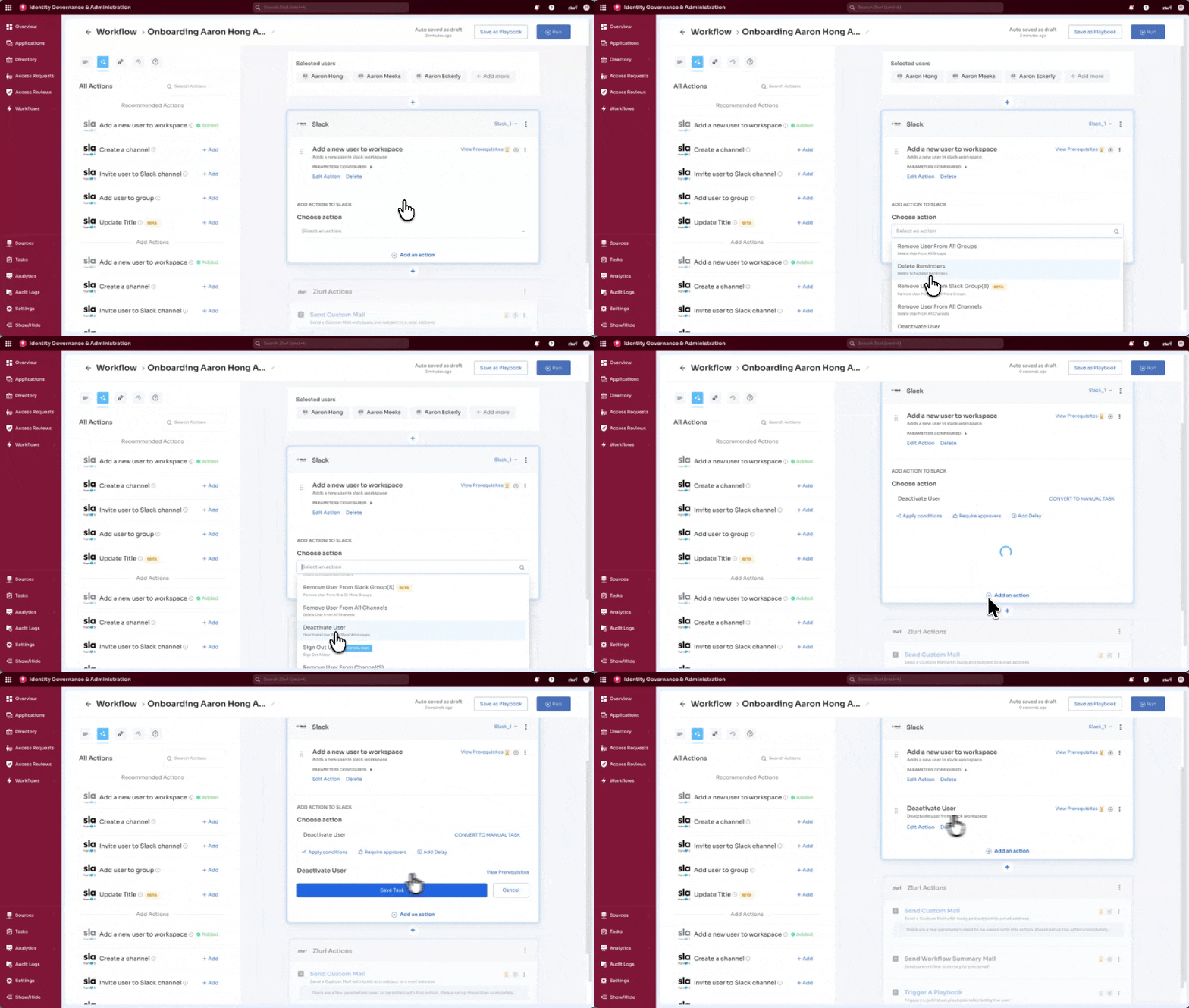
An Admin selecting an action from the 'Delete' group in the Slack app sees actions related to removing users from the workflow, such as "Deactivate User," which will deactivate a user from the Slack workspace.
Action Groups Available
| Action Group | Description |
|---|---|
| Add | Used during onboarding/provisioning. Contains actions related to granting access or provisioning new resources. |
| Delete | Handles removal or deactivation during offboarding. Used for departing employees, role changes, or access revocation/downgrade. |
| Update | Applies to both onboarding and offboarding. Used to manage user details, profiles, or access levels (For example, reset password, update user type). |
| Zluri Actions | Actions specific to the Zluri IGA platform. Involves applying settings, making changes, or configuring elements within Zluri (For example, adding users, assigning app-specific roles, updating app status). |
Example: If John is a new joiner needing admin access to Slack, the playbook may include: An onboarding action adding him to a Slack channel. A Zluri action marking him as a Slack admin in the Zluri system. |
| Others | Typically includes "Create a Manual Task." In the Zluri Action app block, it lists: Create a Manual Task, Make an HTTP Request, Make an HTTP Request with Callback. Manual Task: Creates a task in the Tasks section for manual completion. Used for unavailable automated actions or preferred manual execution.
Learn more about Manual Tasks |
| Custom Actions | Displays actions custom-built by Zluri admins to support automations not available through Zluri's out-of-the-box capabilities.
Learn more about Custom Actions |
| SSO (Single Sign-On) Actions | Automations run through SSO systems (Okta, Azure AD, Google Workspace) acting as a centralized identity layer. Includes adding users to groups or applications on SSOs to handle authentication automatically or support provisioning through SSOs. |
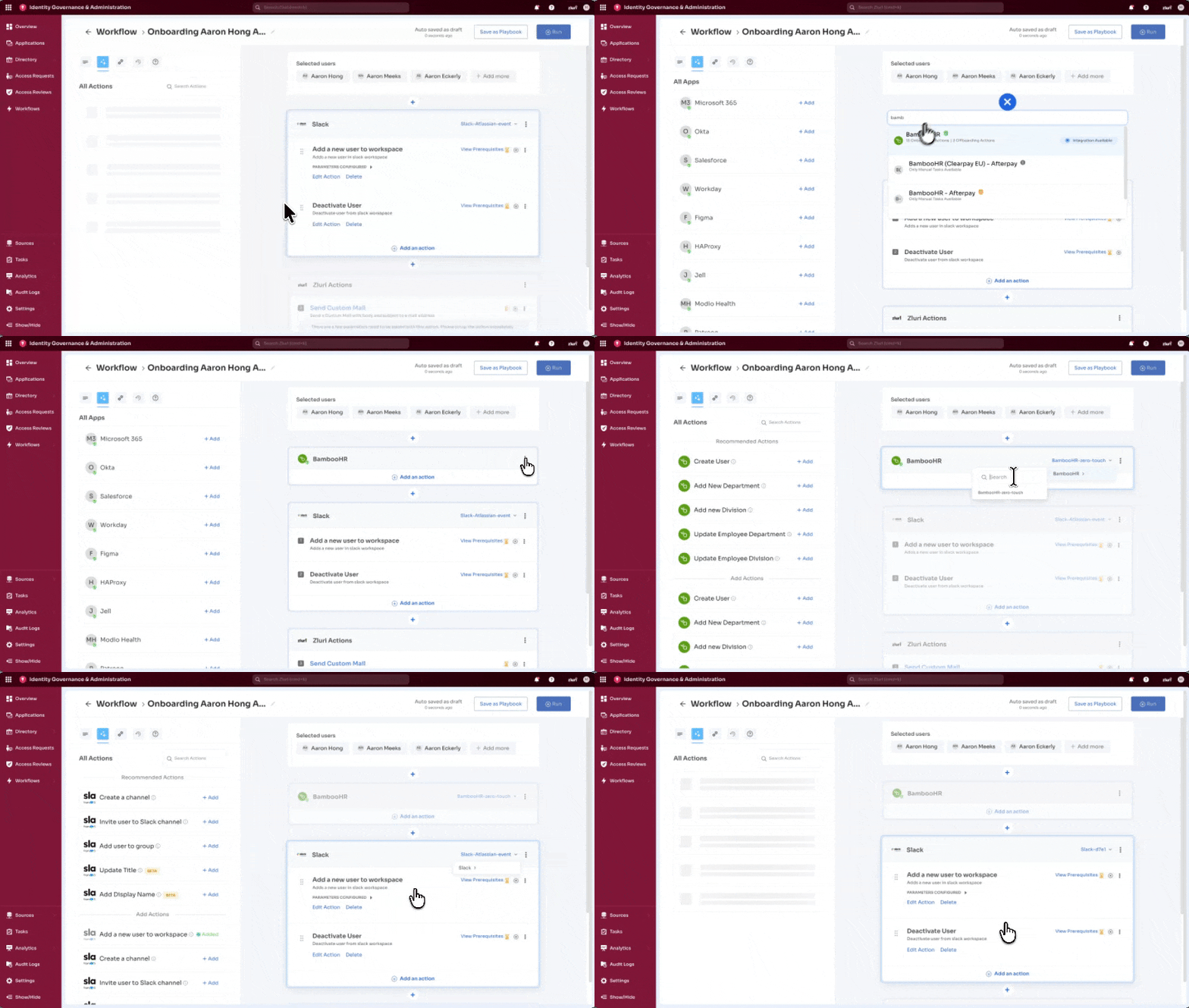
Add an Action
At the bottom of each app block, select + Add an action to open the action selection menu.
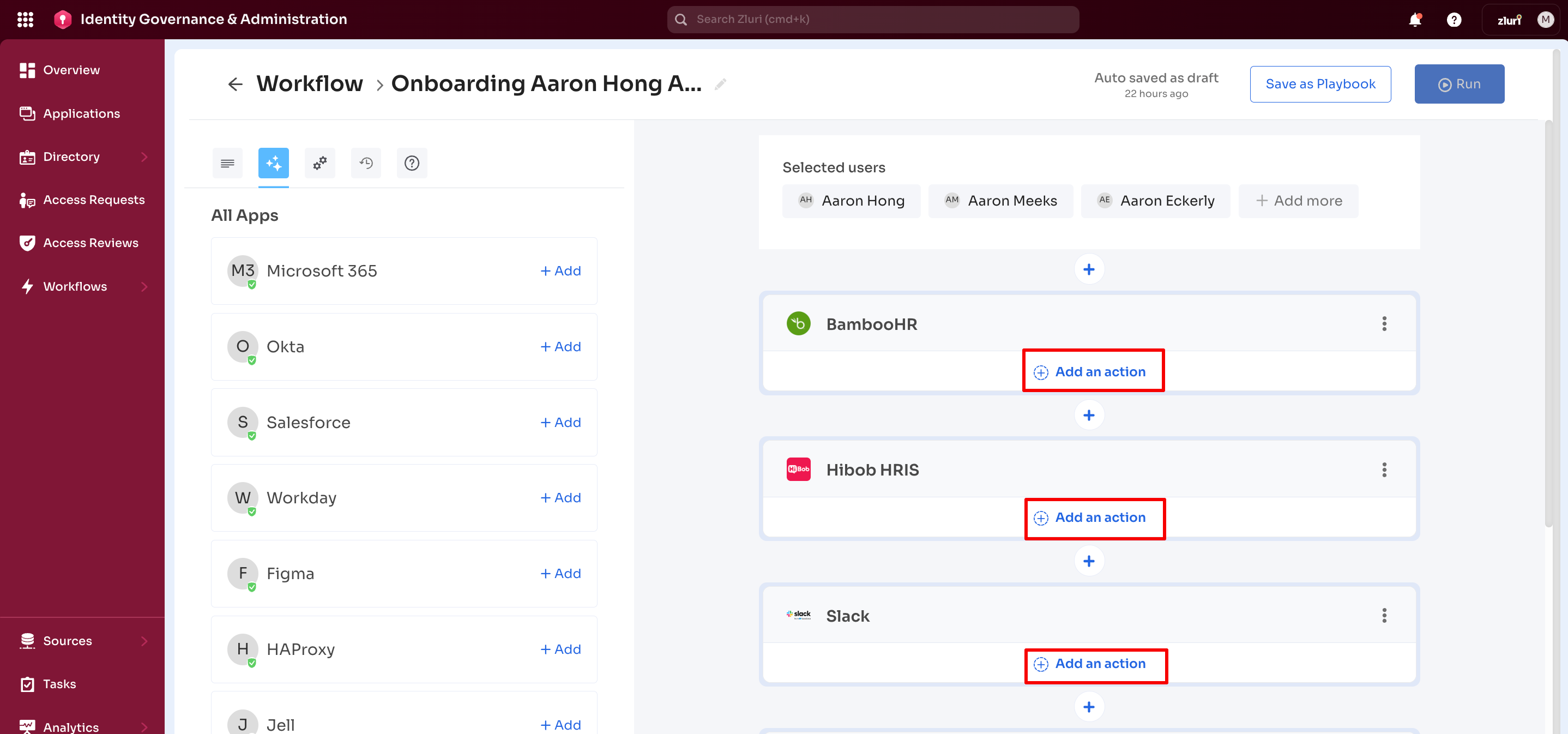
Choose Action Menu
A Choose Action menu appears displaying actions grouped by type. Available groups include:
- Add - Actions to provision or add resources
- Update - Actions to modify existing configurations
- Manual - Tasks requiring human completion
- Zluri Action - Platform-specific actions
- Delete - Actions to remove or deprovision resources
- Custom Actions - User-created custom integrations
- Others - Miscellaneous actions
The list of available actions depends on the selected application.
Example: Slack Application Actions
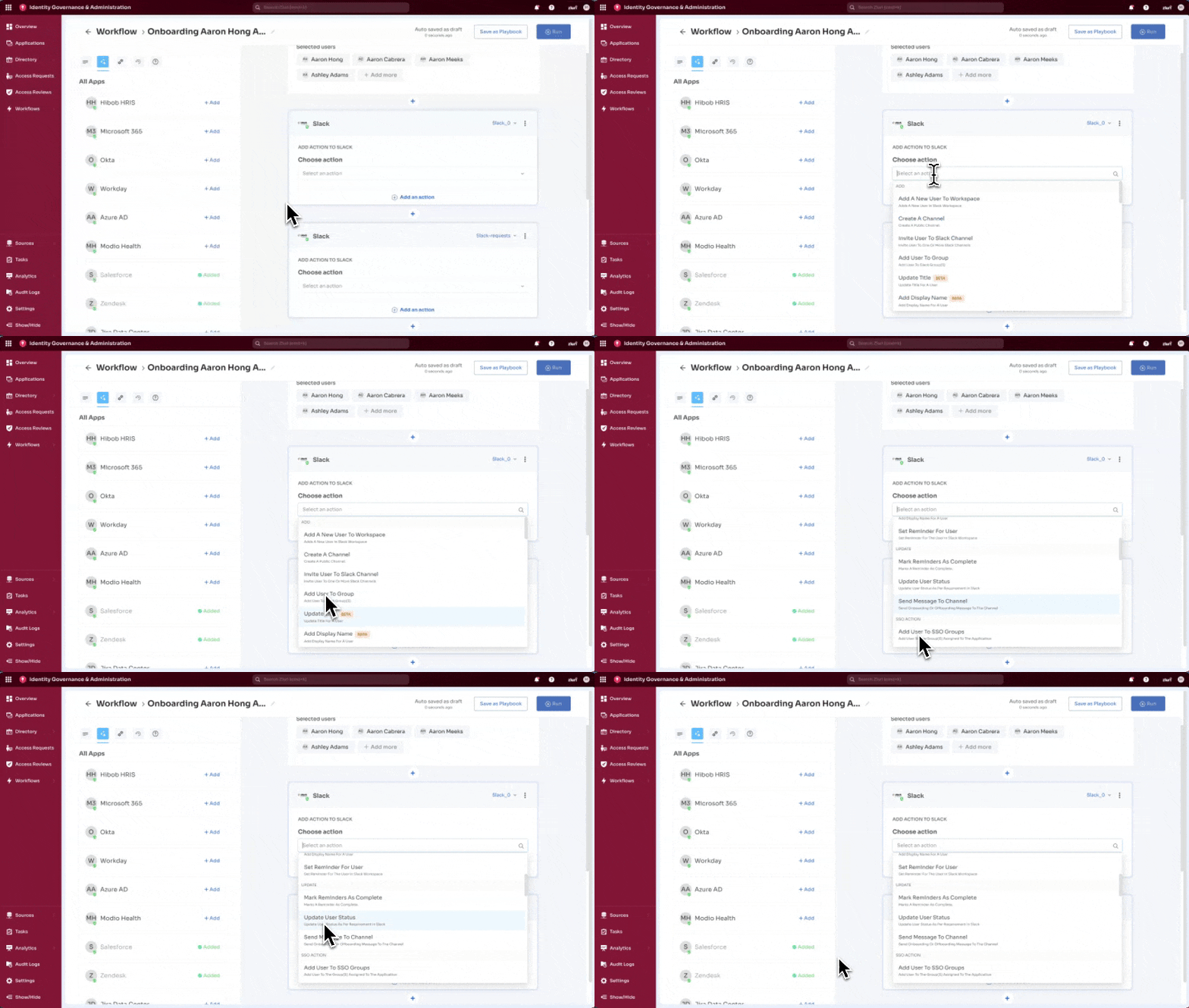
Upon selecting Choose Action for the Slack app, actions are grouped as follows:
Add group - Actions to perform operations related to adding users:
- Add a New User to Workspace
- Create a Channel
- Invite User to Slack Channel
- Add User to Group
- Update Title
- Add Display Name
- Set a Reminder for the User
Update group - Actions for modifying existing configurations:
- Mark Reminders as Complete
- Update User Status
- Send a Message to the Channel
Available action groups vary by application. Slack shows Add and Update groups for onboarding; other applications may show different groupings based on their capabilities.
Configure Action Parameters
After selecting an action (For example, "Add a new user to workspace" for Slack), a configuration window opens with multiple options.
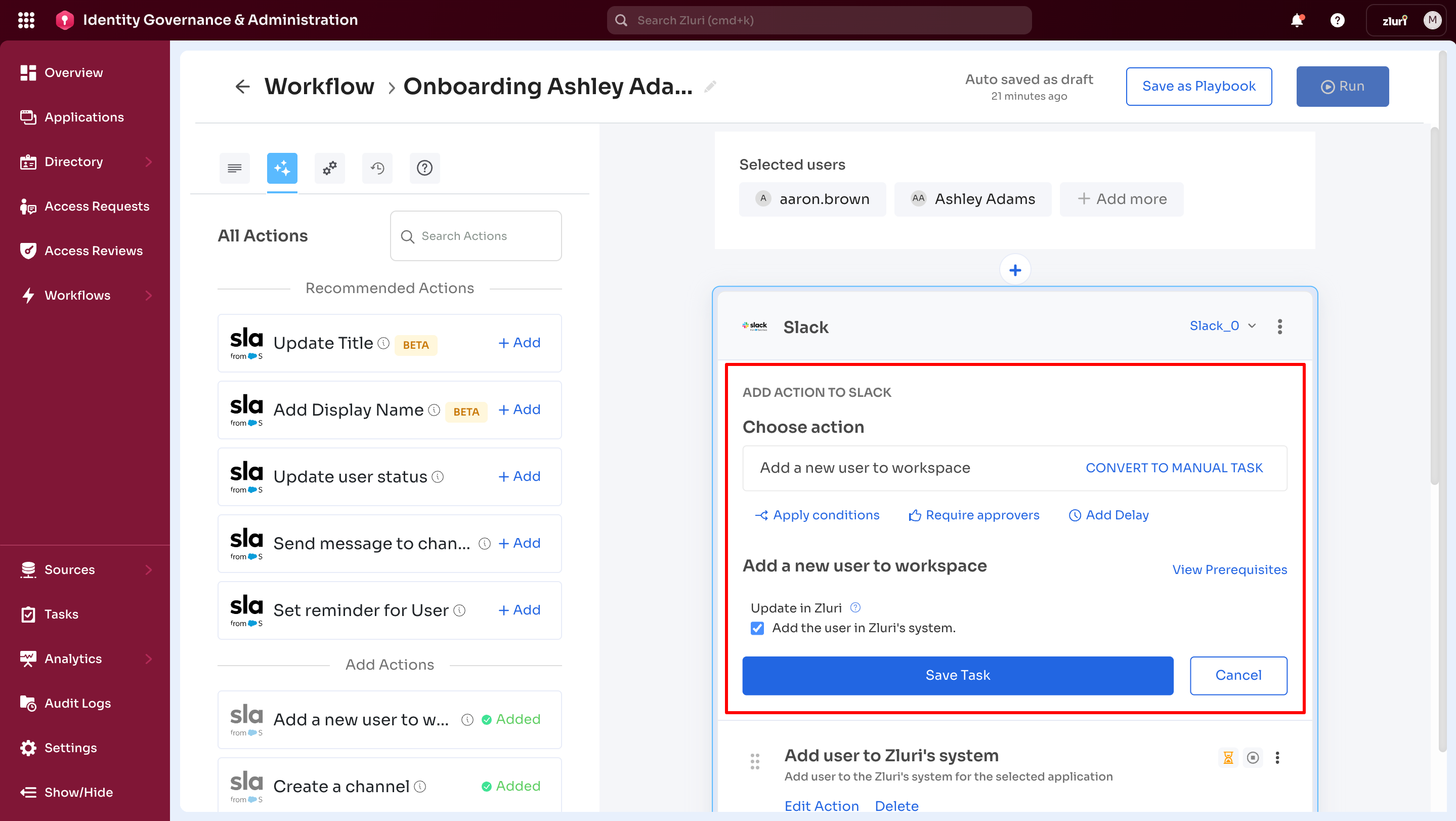
Convert to Manual Task
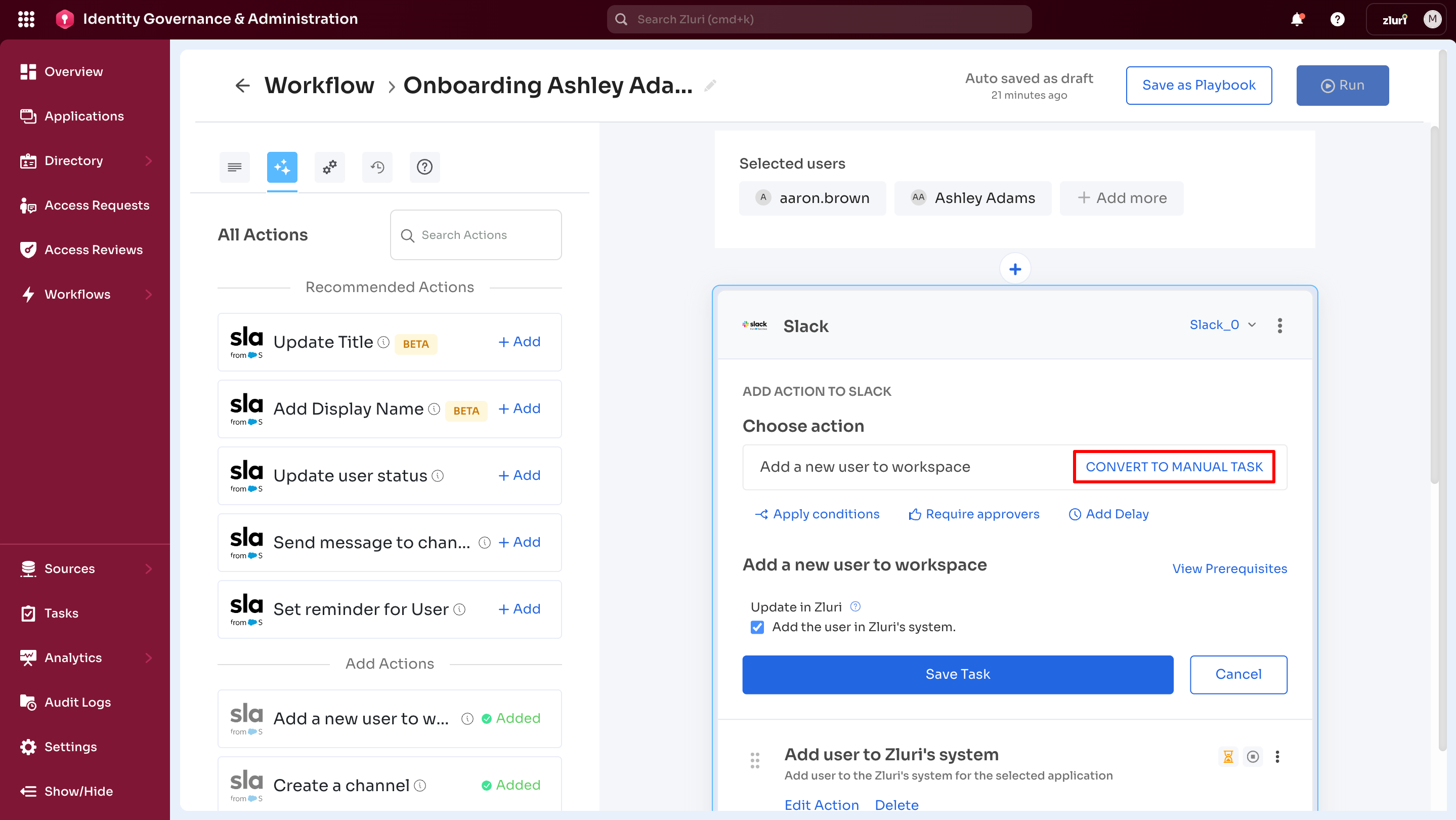
Convert automated actions to manual tasks if manual execution is preferred for security or process reasons.
Use cases:
- Security requirements mandate manual approval
- Actions require special handling
- Automation not suitable for sensitive operations
Advanced Features
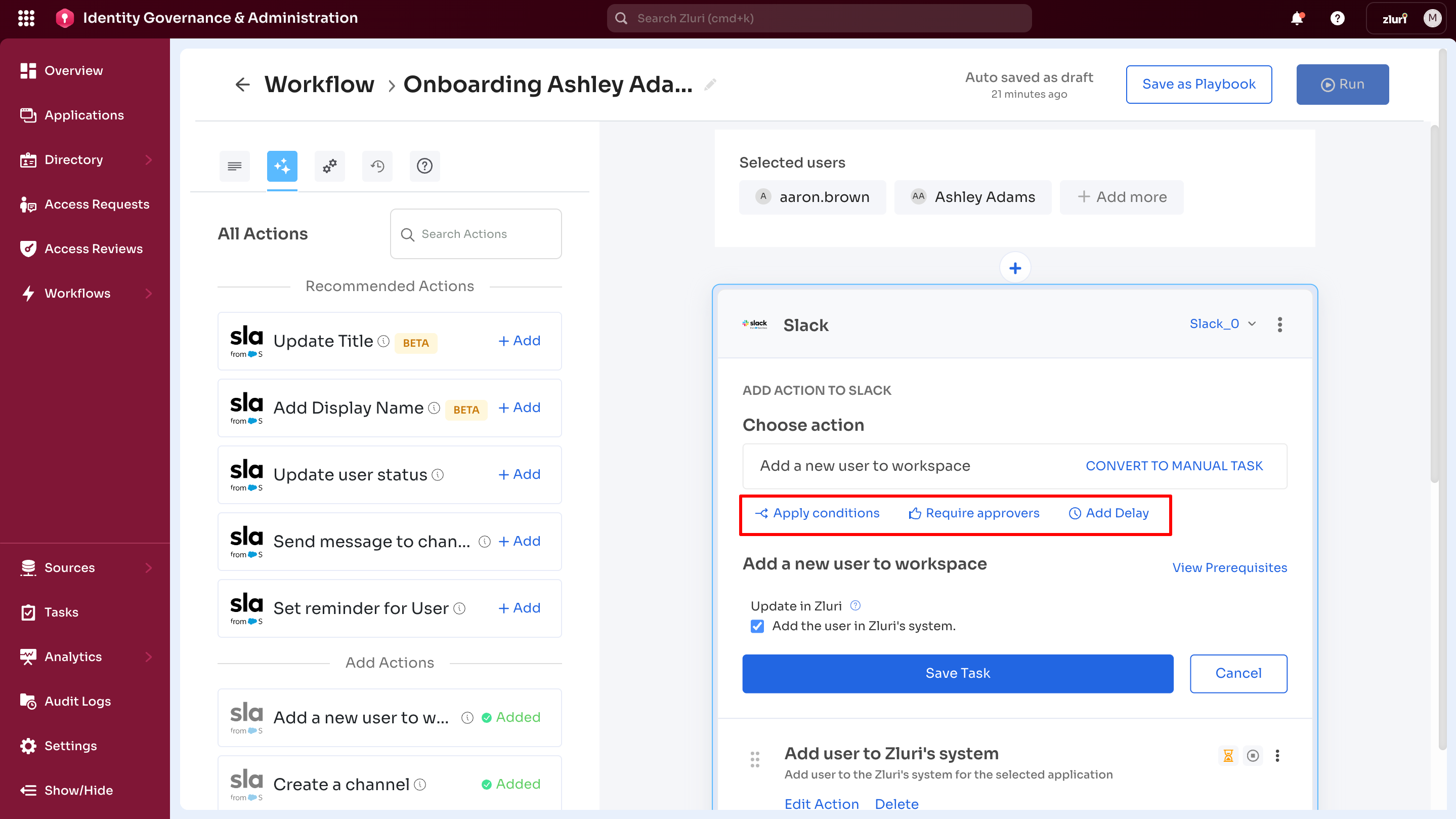
Apply Condition
Set rules determining this specific action's execution based on user attributes (role, department, status, etc.).
Example: Only invite user to #engineering-team channel if department = Engineering
Conditions use user attributes like:
- Role
- Department
- Location
- Designation
- Status
- Account type
Learn more about setting conditions
Require Approvers
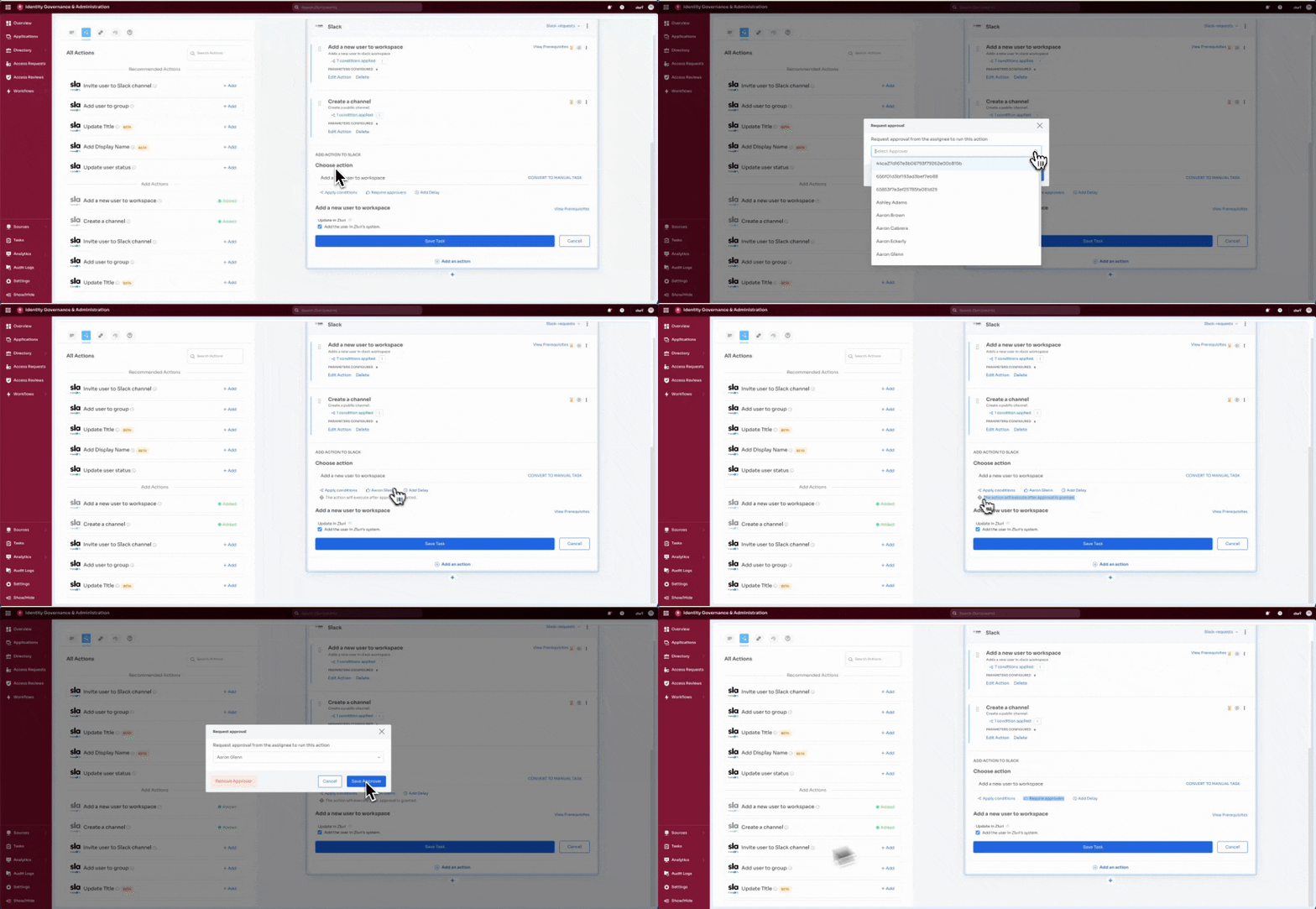
Assign approvers for sensitive actions. Adds an extra layer of control ensuring high-impact actions are reviewed and explicitly approved before execution.
Method to follow:
- Specify one or more approvers
- During workflow runs, approvers receive notifications
- Action executes only after approval
- If approval is denied, action is skipped
Use cases:
- Granting admin access
- Assigning expensive licenses
- Providing access to sensitive data
Add Delay
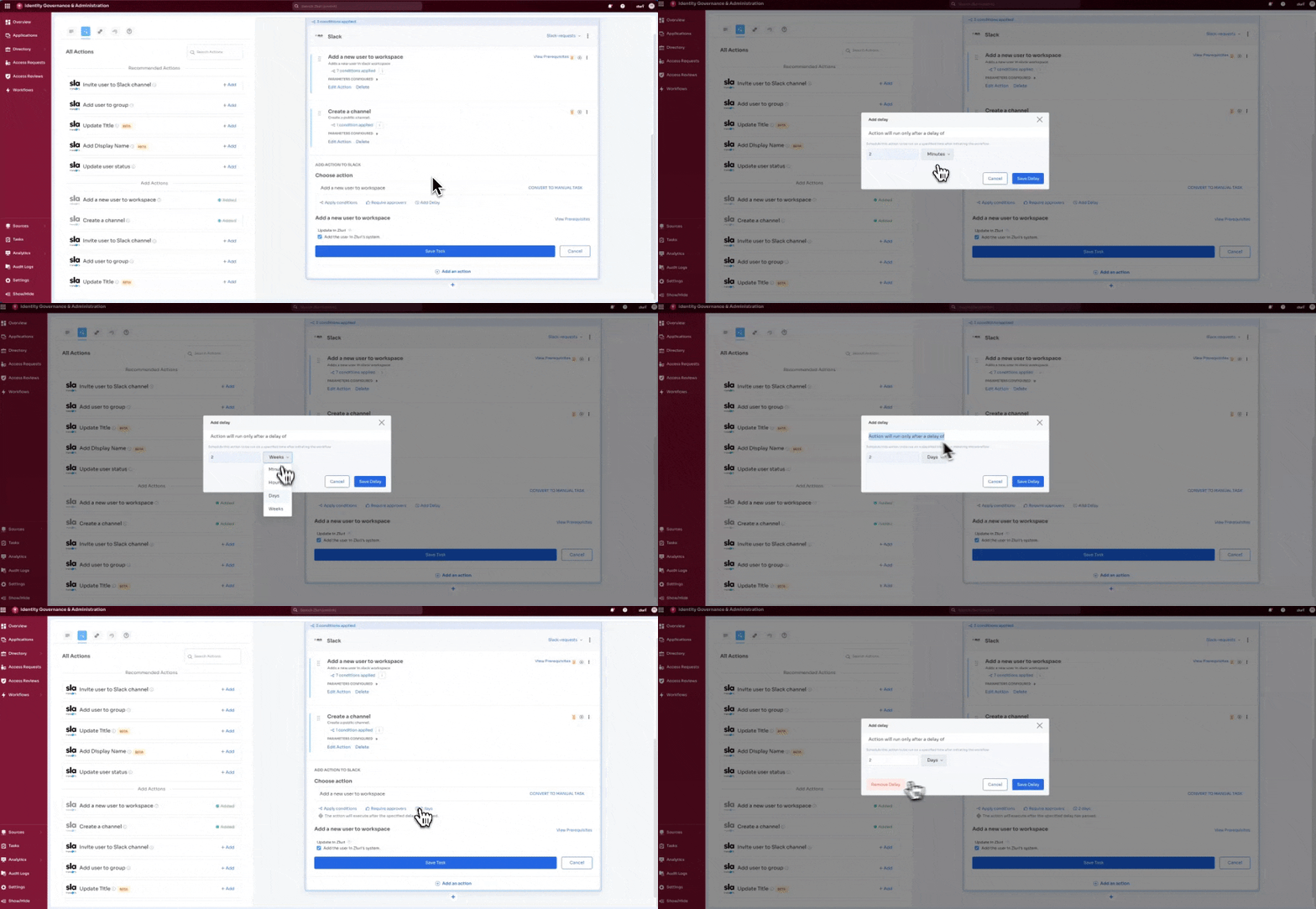
Schedule action execution timing after playbook trigger. Configure delay in:
- Weeks
- Days
- Hours
- Minutes
Use cases:
- Send welcome email 1 day after account creation
- Assign advanced tools after 1 week probation
- Trigger training modules after 3 days
Delays help sequence actions and ensure staged provisioning.
View Prerequisites
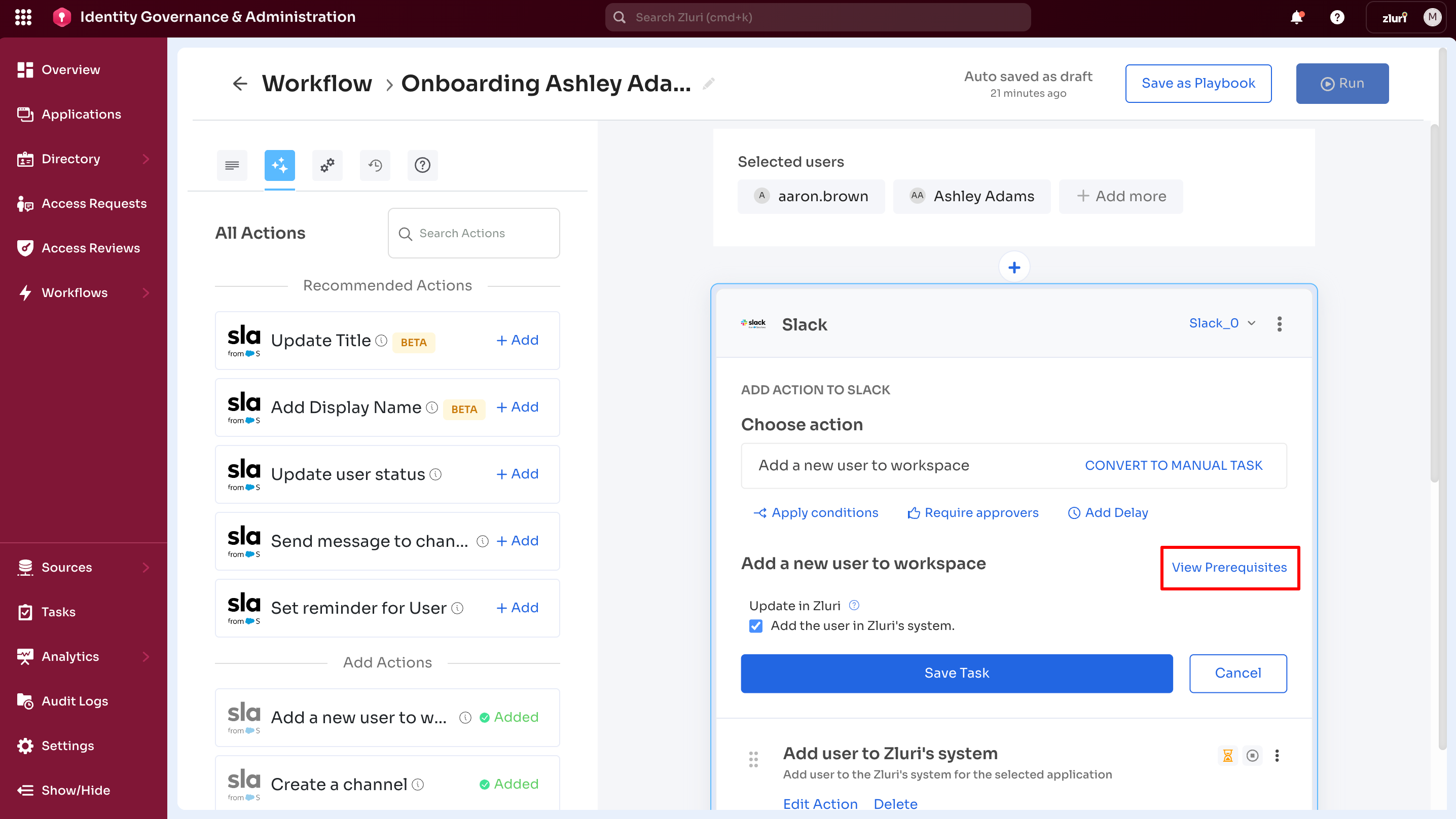
Displays prerequisites necessary for successful action execution.
Common prerequisites:
- Plan tier requirements - Certain actions only work on higher-tier plans (Basic/Business vs. Enterprise)
- License requirements - Specific licenses needed for the action
- Integration requirements - Required connections or permissions
Different actions have different prerequisites, clearly indicated so admins can verify requirements while setting up the workflow.
Important: The workflow cannot run and the playbook cannot be saved until all required prerequisites are met. If prerequisites aren't met, the action will fail.
Update in Zluri
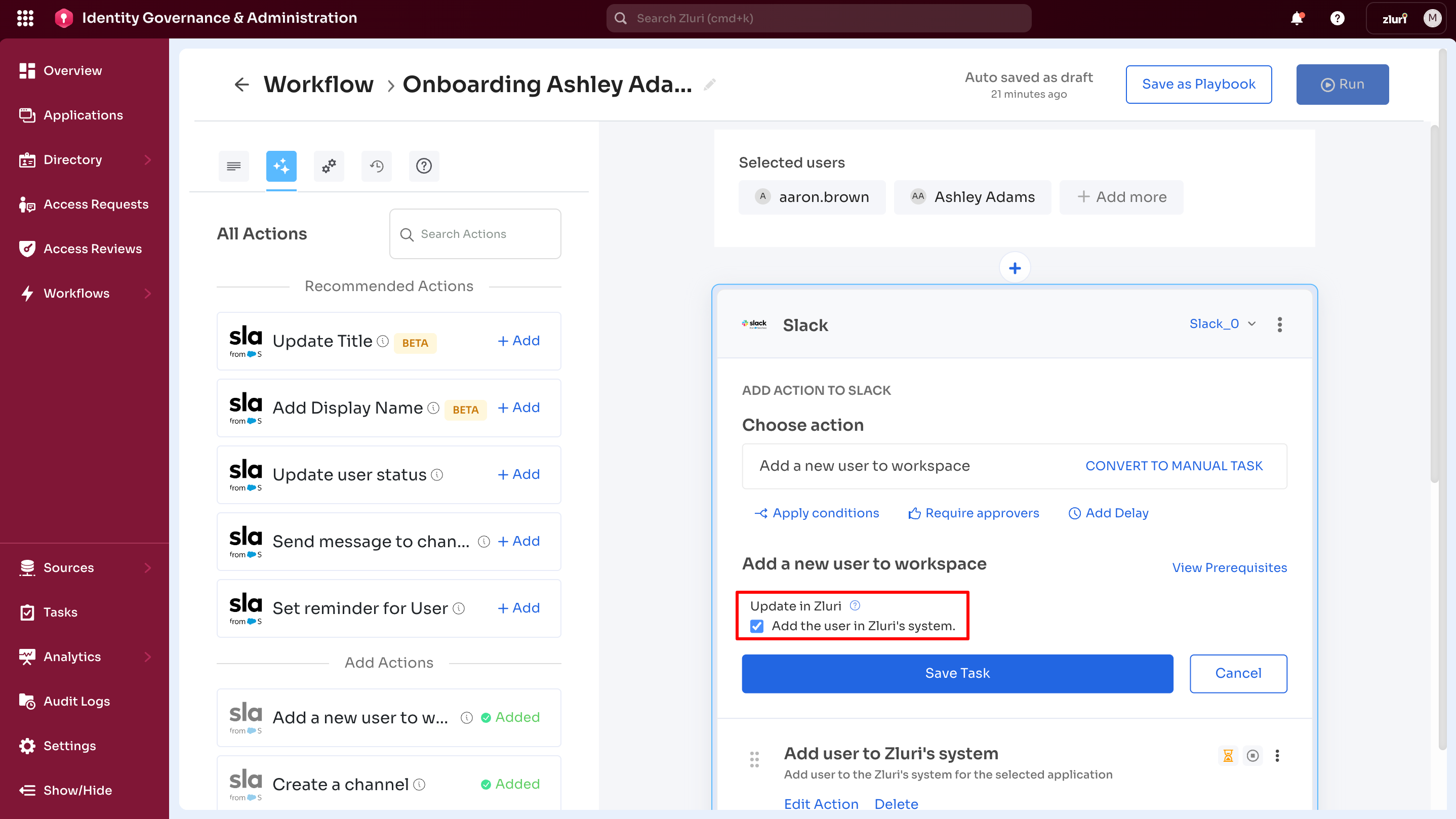
(Appears only for Add and Delete type actions)
This checkbox automatically adds or removes the user from the application in Zluri's system upon completion of the action.
Benefits:
- Keeps Zluri's records synchronized with actual application access
- Ensures accurate license tracking
- Maintains up-to-date user directories
Enable during:
- Add actions: Automatically registers user as having access
- Delete actions: Automatically removes user from Zluri records
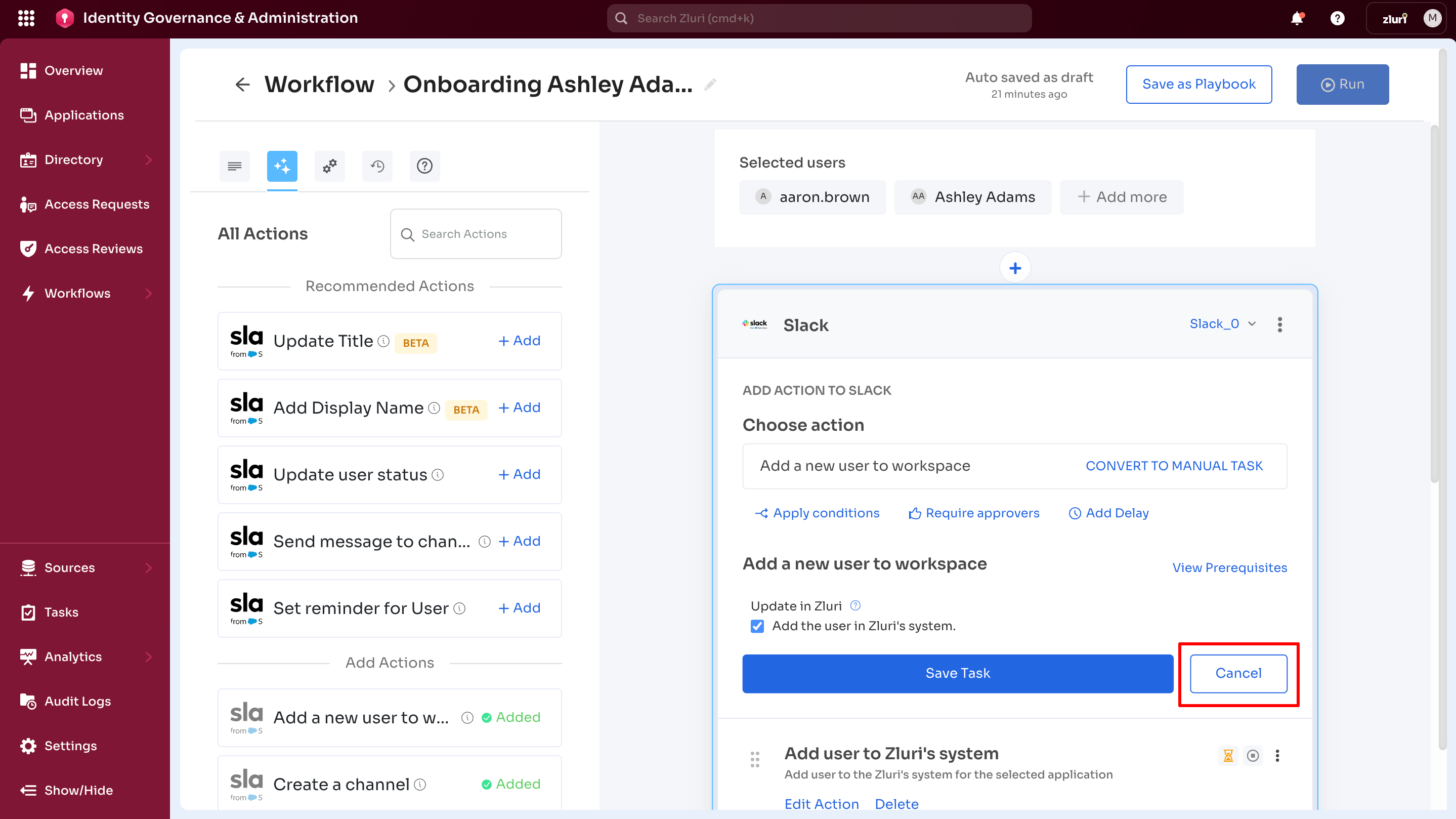
Save Task / Cancel
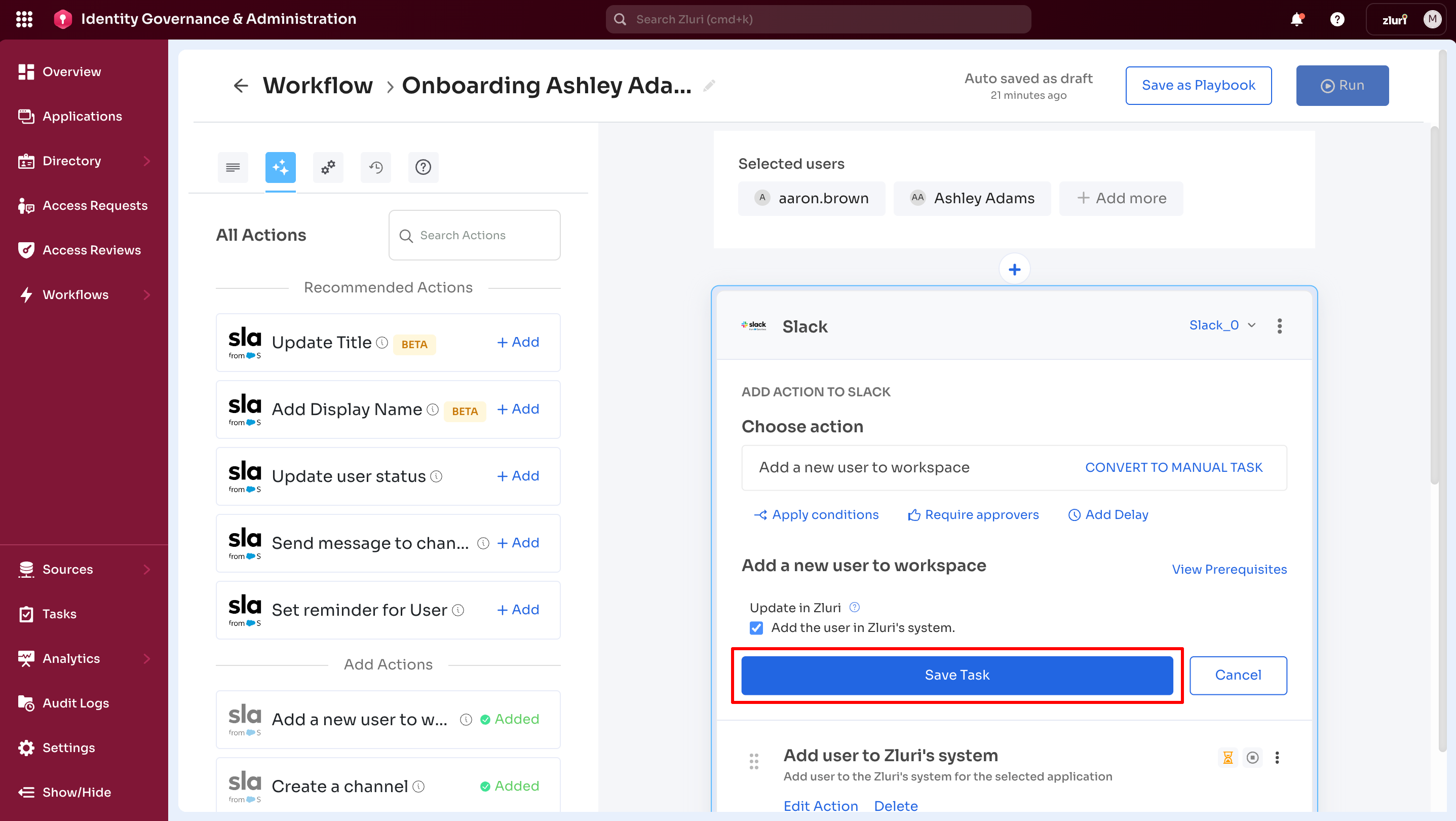
Save Task
Saves the action configuration. Required for changes to take effect in all subsequent runs of the workflow or playbook.
Cancel
Discards all configurations:
- Adding a new action: Removes all settings and requires setup from scratch
- Editing an action: Reverts to previous configuration
Add Multiple Actions
Select + Add an action at the bottom of the app block to add another action to the same application.
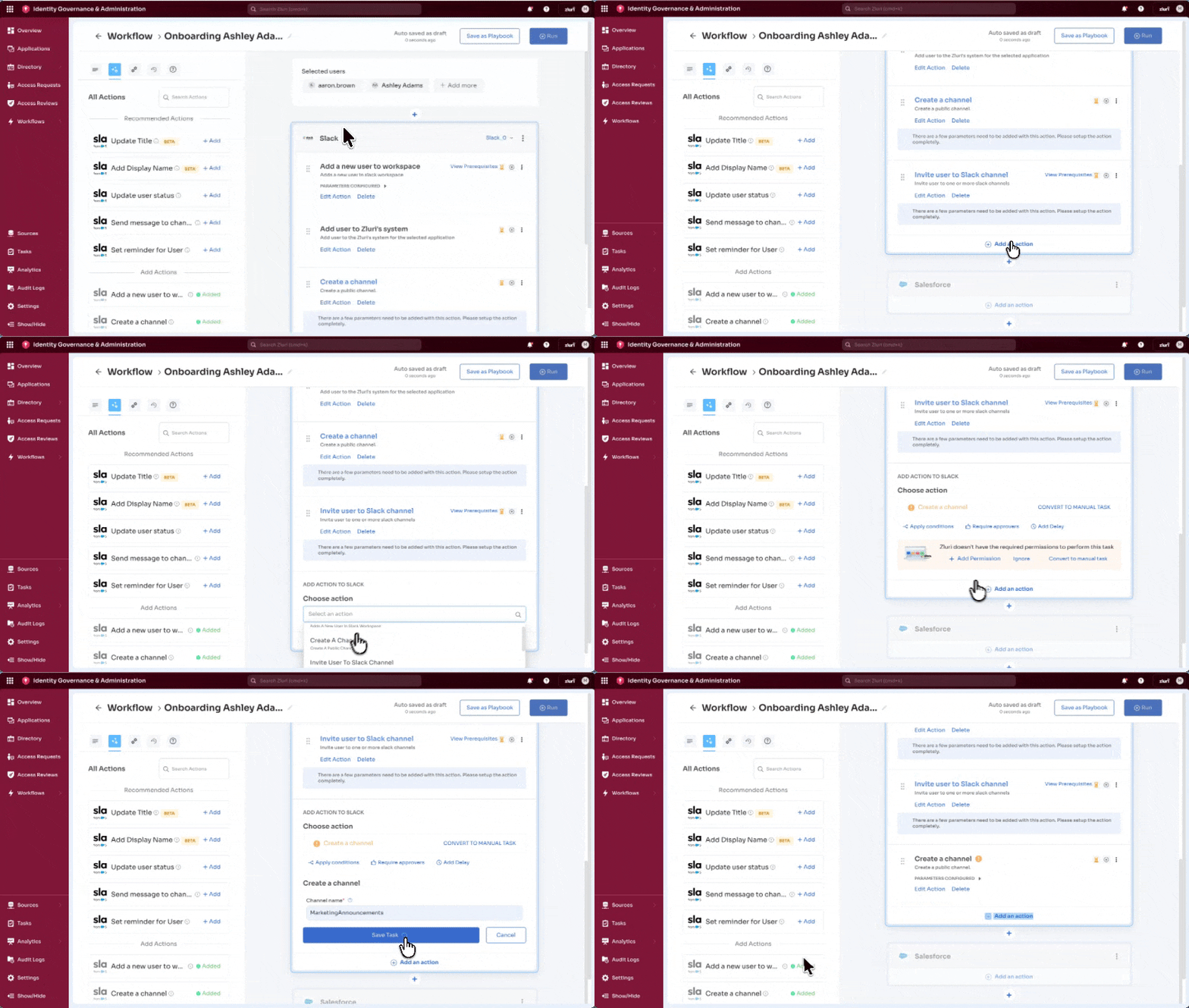
User or admin can add:
- Multiple instances of the same action with different parameters
- Different actions from various action groups
- Mix of automated and manual actions
Example: For Slack, add:
- Add a New User to Workspace
- Invite User to #general channel
- Invite User to #engineering channel
- Add User to Engineering Group
Action Counts Breakdown
Adding an application with integration available displays detailed action counts.
Example: Slack Application
10 Onboarding Actions:
Add actions (7 total):
- Add a New User to Workspace
- Create a Channel
- Invite User to Slack Channel
- Add User to Group
- Update Title
- Add Display Name
- Set a Reminder for the User
Update actions (3 total):
- Mark Reminders as Complete
- Update User Status
- Send a Message to the Channel
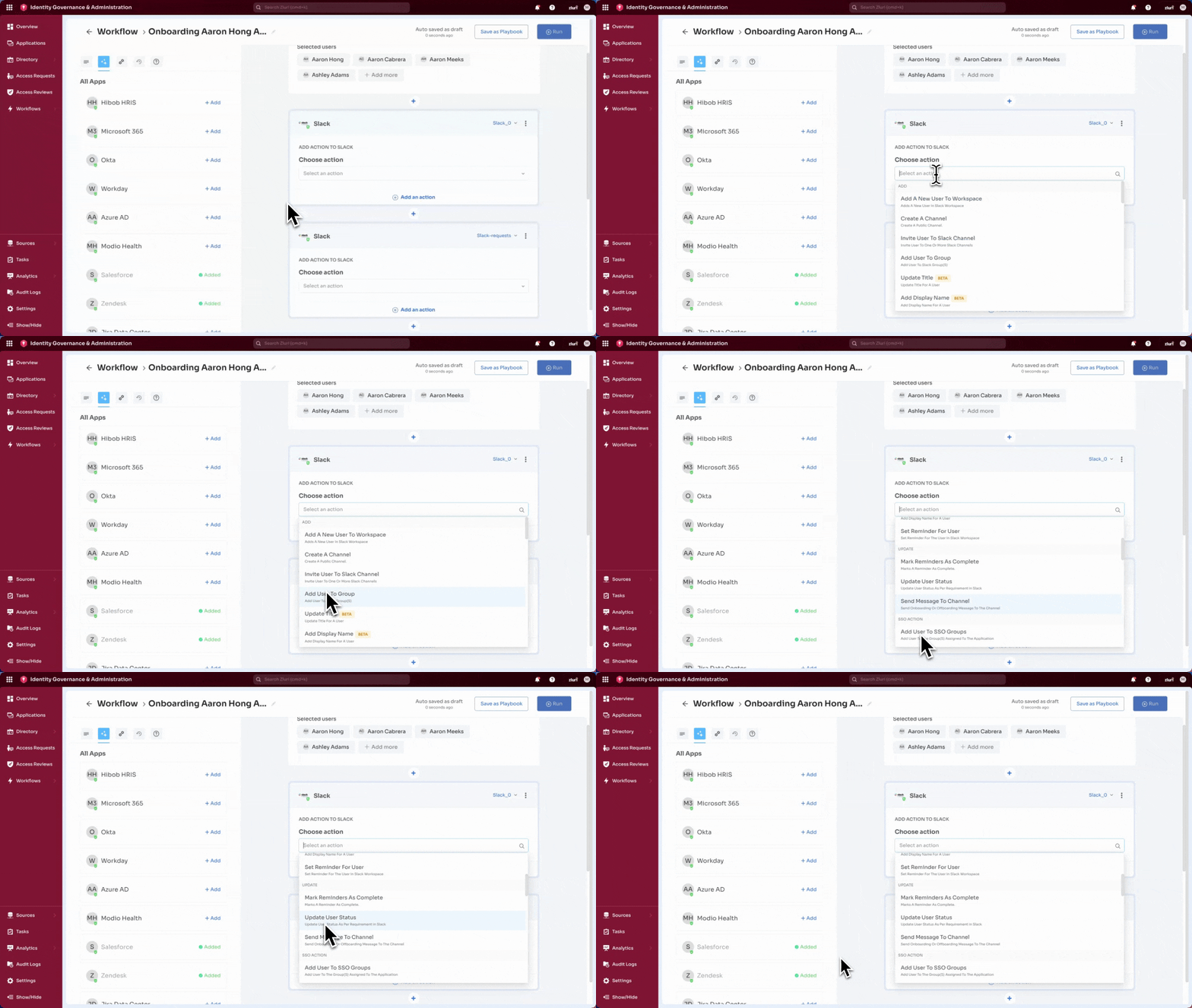
7 Offboarding Actions:
Delete actions (7 total):
- Remove User from all Groups
- Delete Reminders
- Remove User from Slack Group(s)
- Remove User from all Channels
- Deactivate Users
- Sign Out User (Manual task)
- Remove User from Channel(s)
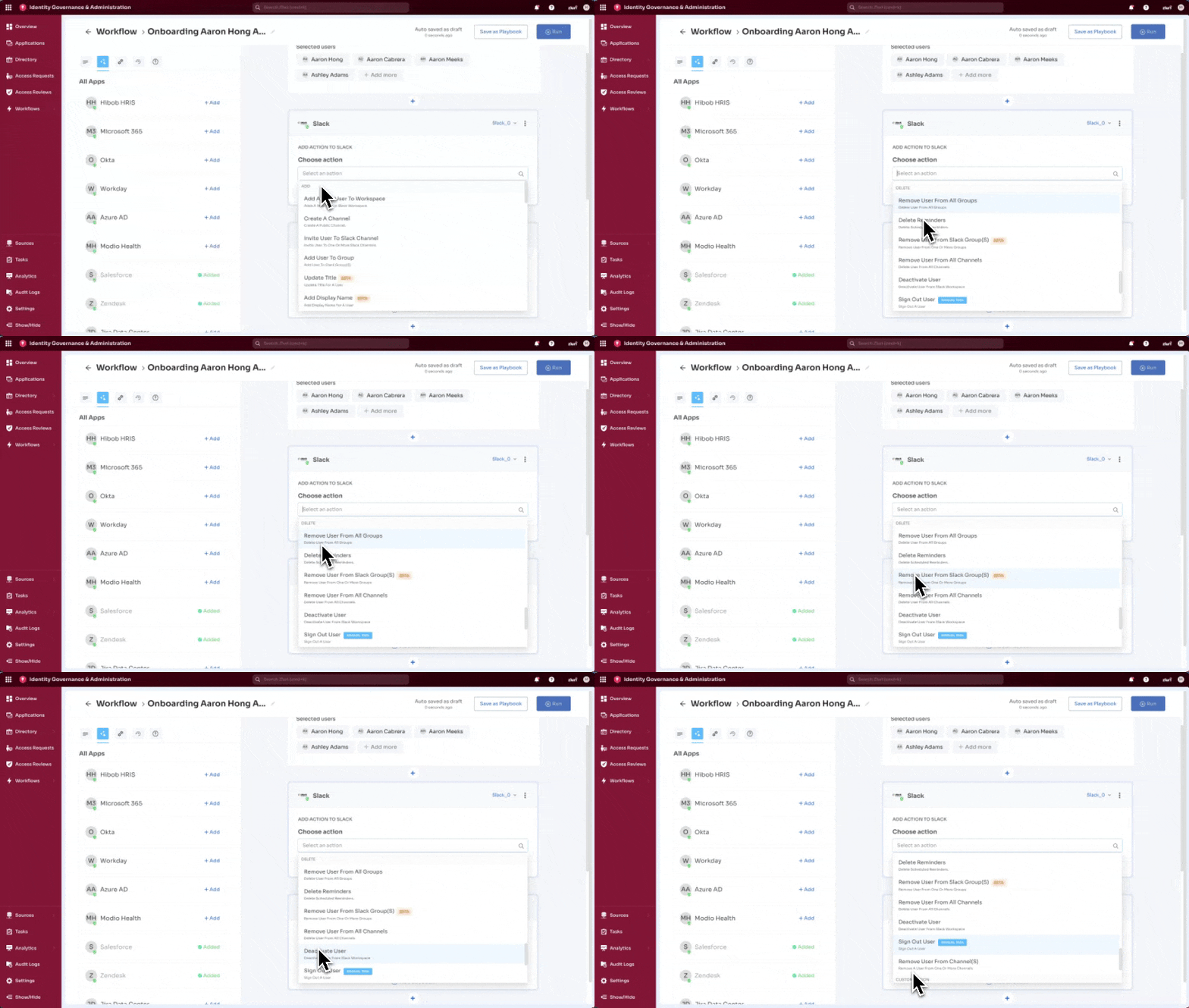
Note: Each application has different actions available. The examples above are specific to Slack. Other applications may have different action types and counts.
Manage Configured Actions
After selecting Save Task, the configuration window updates to show additional controls and information.
Integration Instance Selector
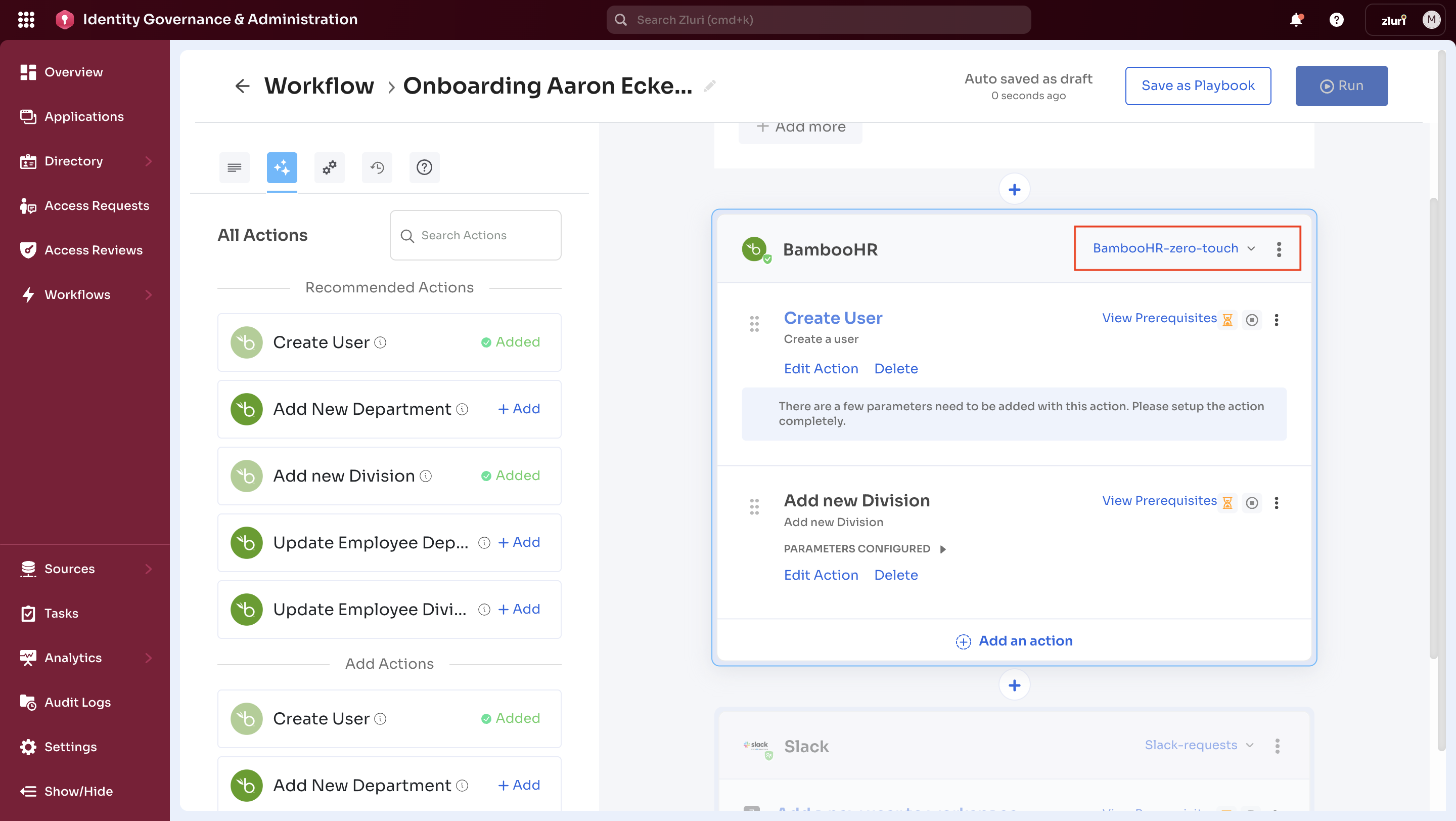
Displays the currently selected integration instance (For example, "BambooHR-zero-touch").
If multiple instances of an application are integrated with Zluri, select the arrow next to the instance name to select a different instance for this workflow.
All integration instance names appear in the dropdown (For example, BambooHR-zero-touch, BambooHR-prod, BambooHR-staging).
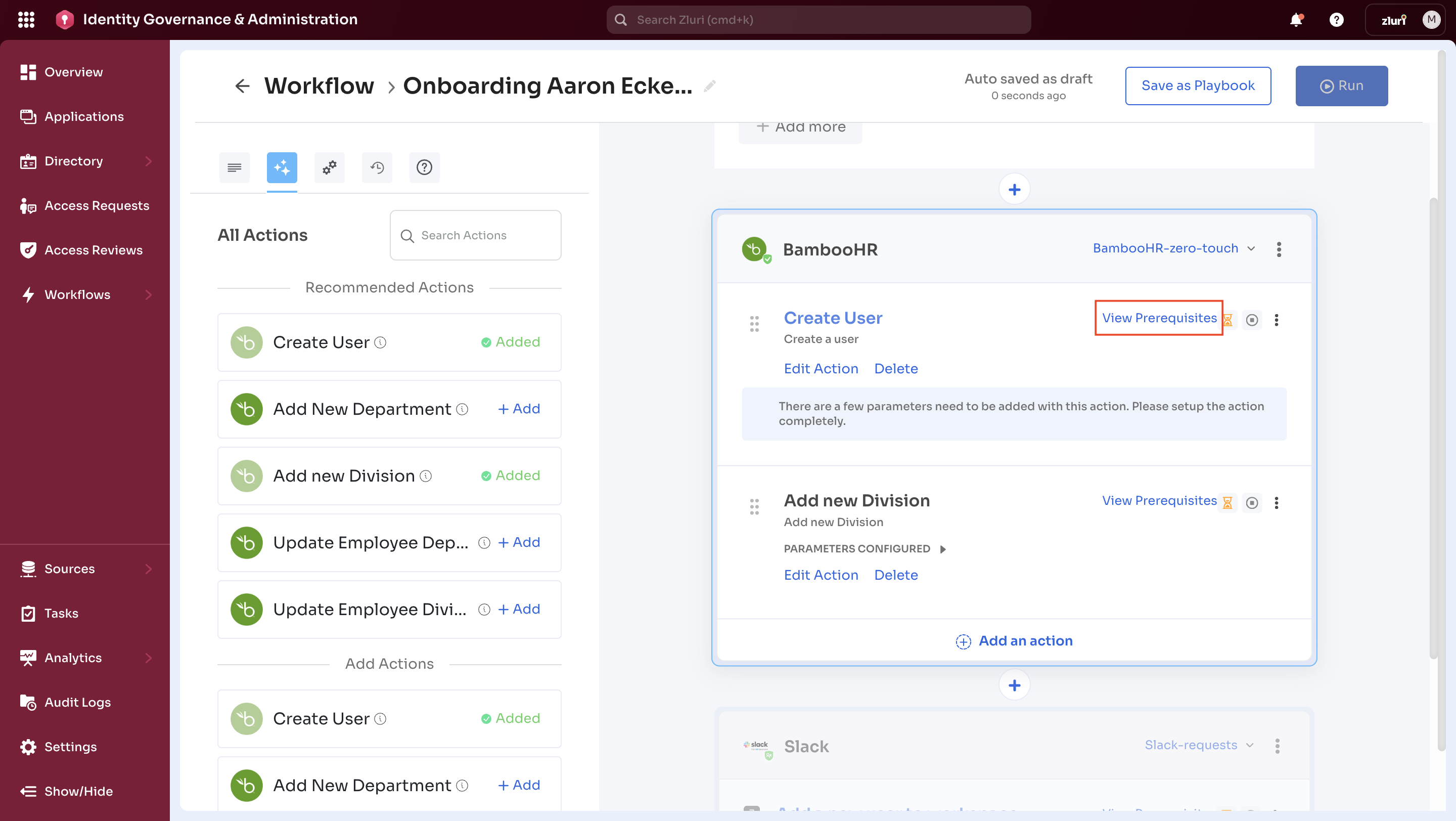
View Prerequisites
Displays prerequisites again for the requirement review. Shows the same information as during initial configuration.
Edit Action / Edit Task
Edit Action - Appears for automated actions. Reopens the configuration window to modify parameters.
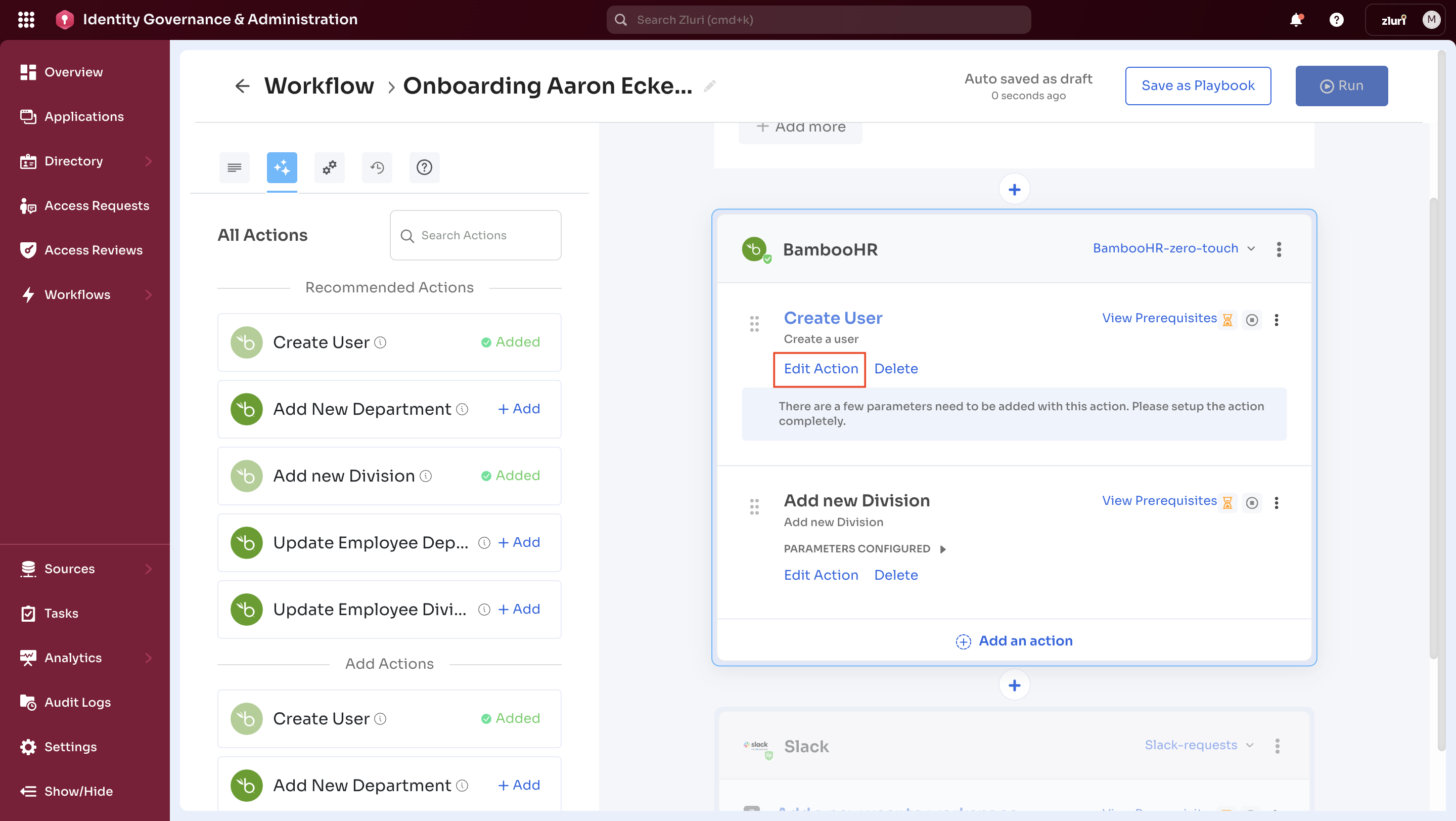
Edit Task - Appears for manual tasks. Similar functionality with manual task-specific fields.
The features and options in Edit Task are nearly identical to Edit Action.
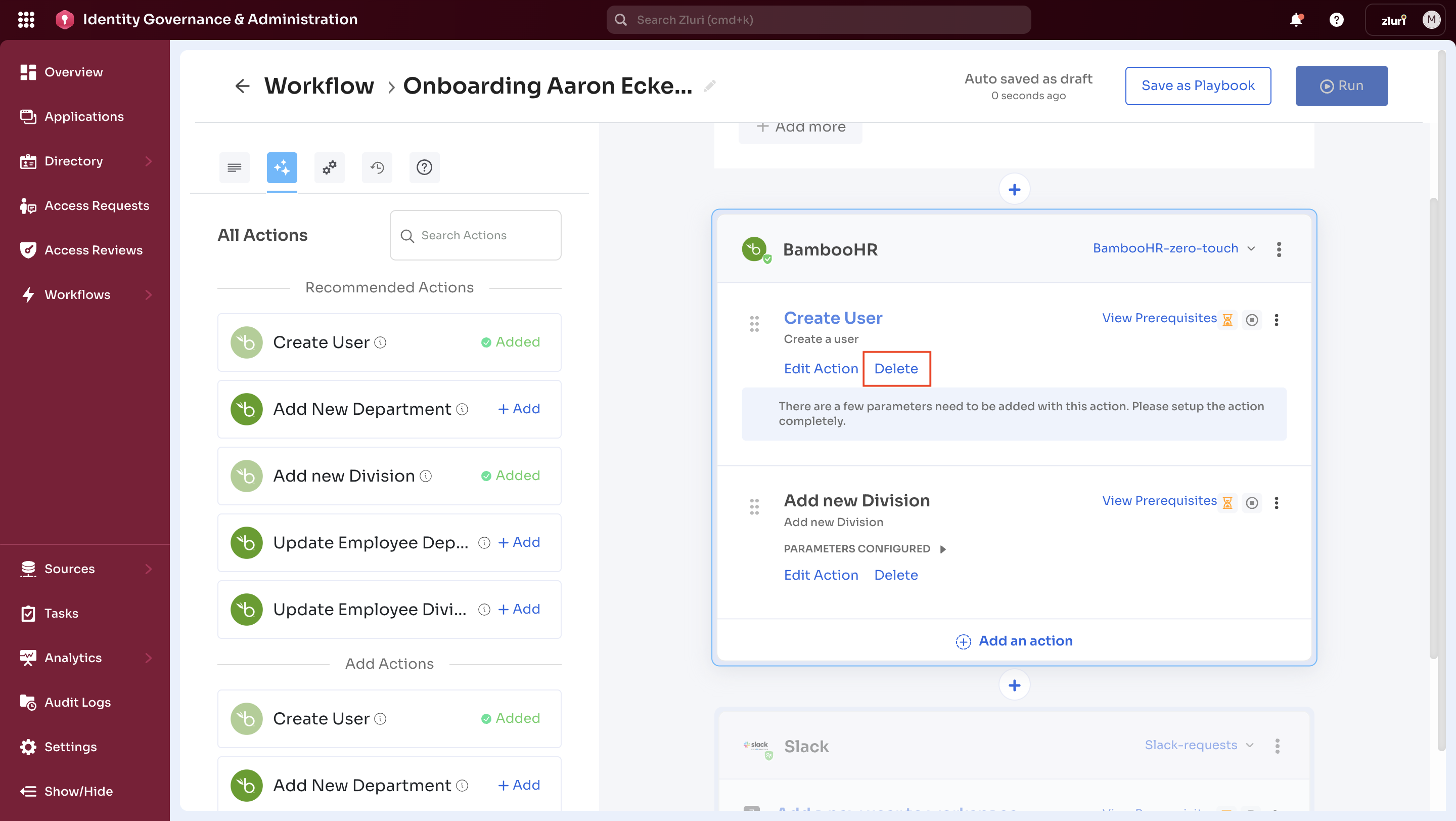
Delete
Removes this action from the workflow completely. The action is permanently deleted and cannot be recovered.
Blue Ribbon Note
This blue ribbon note appears during incomplete or missing parameter configurations, indicating required fields needing completion.
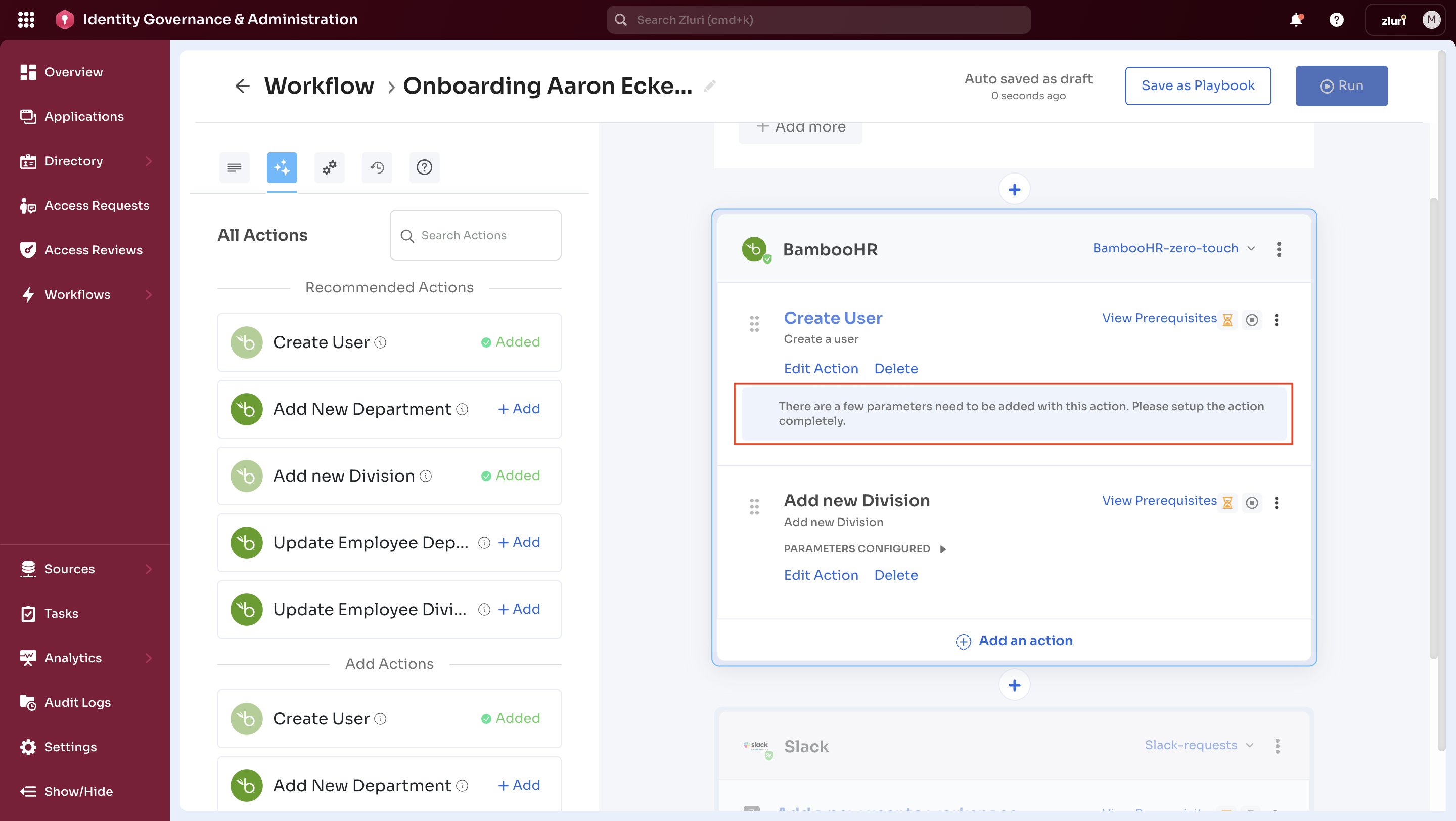
Important: The workflow cannot run, and the playbook cannot be saved until all required parameters are properly configured.
Parameters Configured
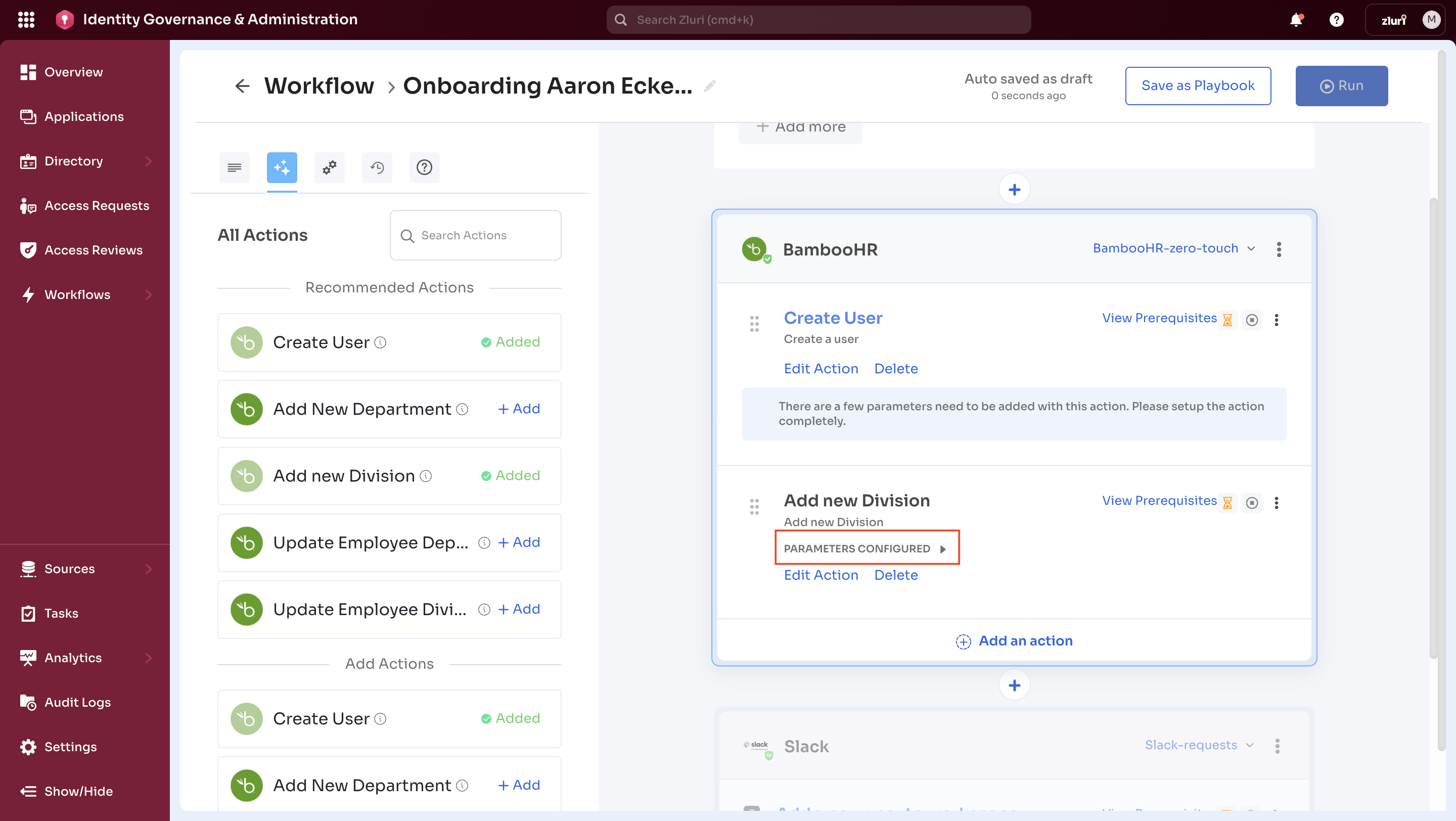
Select the arrow to expand and view all configured parameter details for this action.
Shows the complete configuration, including:
- Parameter names and values
- Applied conditions
- Assigned approvers
- Configured delays
- Integration instance
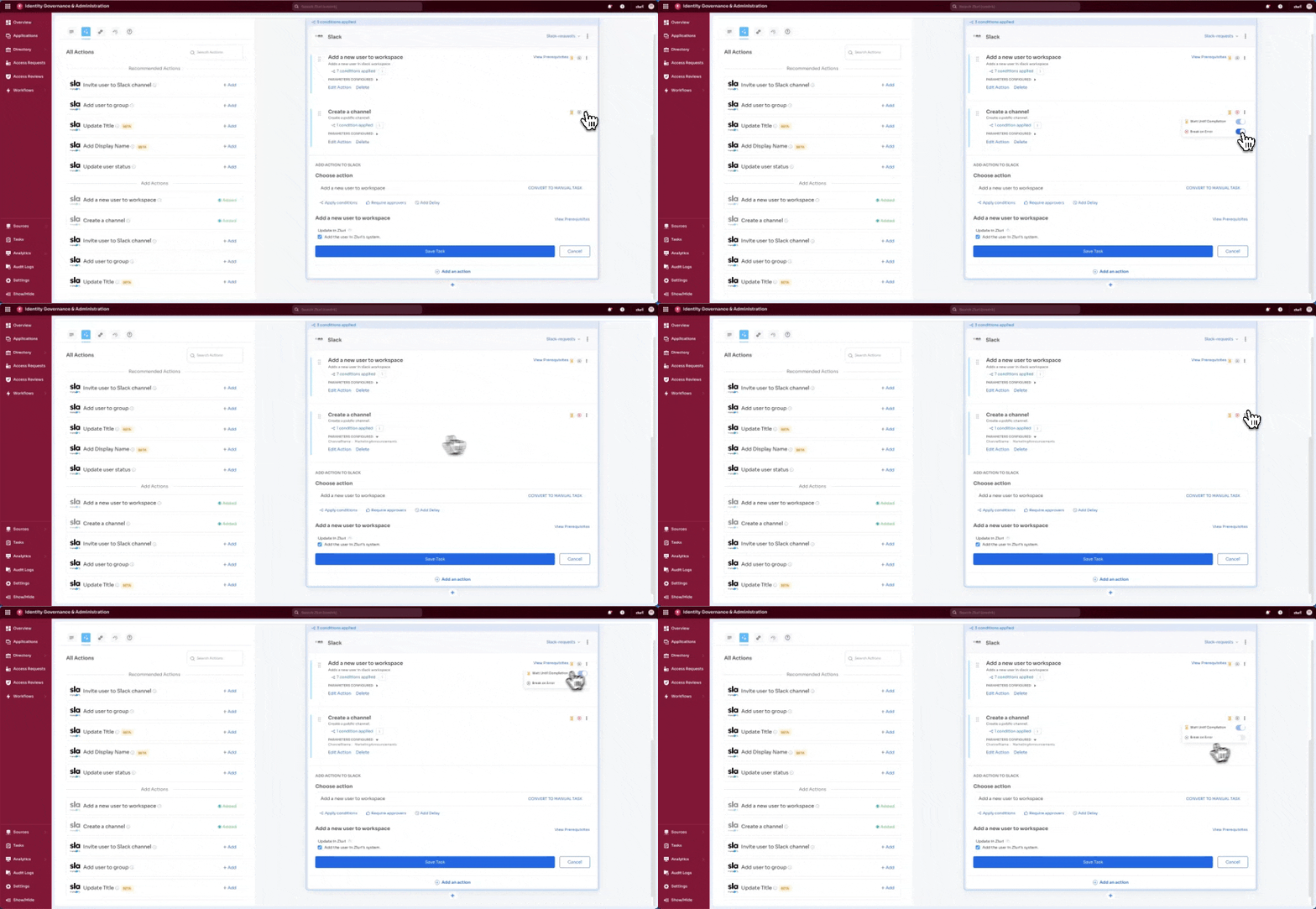
Execution Controls
Three icons appear next to "View Prerequisites" to control the execution of actions.
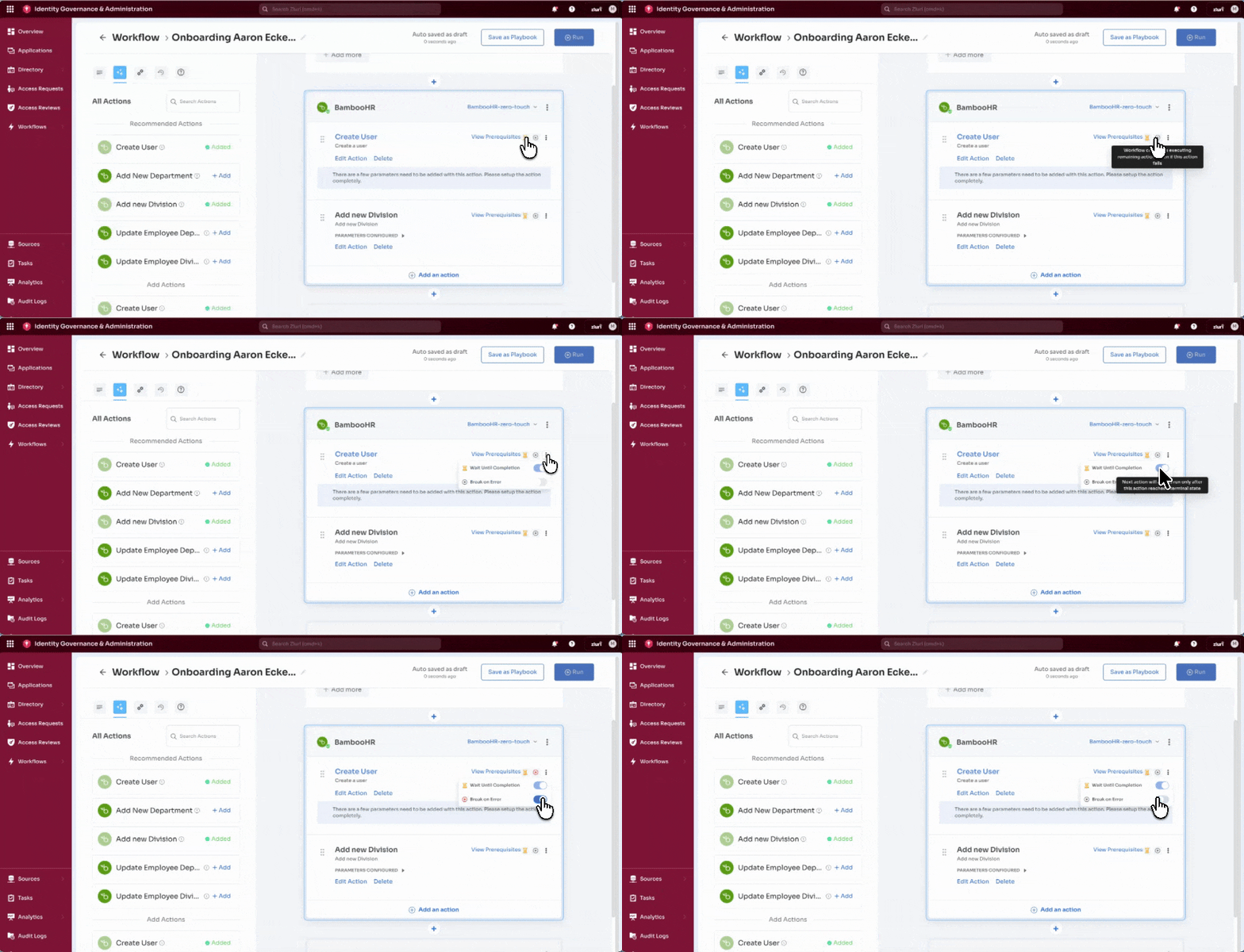
1. Wait Until Completion (Yellow Clock Icon)
Controls whether the next action waits for this one to complete.
Functionality:
The next action executes only after this action reaches a terminal state (completed or failed, including approval not granted).
Note: For automated actions, this is always ON and cannot be turned OFF. Automated actions must execute sequentially to ensure workflow completion and data integrity.
2. Break on Error (Toggle Switch)
Controls workflow behavior during action failure.
OFF (default - grey switch)
- Workflow continues executing remaining actions even if this action fails
- Subsequent actions attempt to run normally
- Useful for non-critical actions
ON (blue switch)
- Workflow stops immediately during action failure
- No further actions are performed
- Prevents cascading errors
To enable:
Select the three-dot menu next to the icon and toggle the switch.
Use cases for Break on Error ON:
- Critical provisioning steps (For example, creating user account)
- Actions on which other steps depend
- Security-sensitive operations
Use cases for Break on Error OFF:
- Optional actions (For example, adding to non-critical groups)
- Actions failing without affecting workflow success
- Nice-to-have provisioning steps
3. Three Dots Menu
Contains the same controls (Wait Until Completion and Break on Error) with ON/OFF sliders to activate or deactivate for specific actions.
Provides quick access to execution control settings without opening full configuration window.
Next Steps
After configuring actions, learn to control execution timing using conditions.
Updated 6 months ago