
Source prioritization and primary source settings
Source prioritization
Source prioritization controls which sources Zluri uses to determine whether an application user or account is active or inactive.
Previously, Zluri supported only a single source per app, with no ordering, no fallback, and no way to apply a consistent rule across apps. Source prioritization gives you control over this logic at both an org-wide and a per-app level.
Source prioritization enables the following:
- Prioritize across all sources. Decide the order in which Zluri uses each source to determine application user and account status, rather than relying on just one.
- Configure at two levels. Set a global, org-wide default that applies to all apps, or a per-app setting for apps that need something different.
- Give multiple sources equal precedence. Rank multiple sources at the same level when you treat more than one source as a source of truth for an app's user or account status.
Priority groups
A priority group is a set of two or more sources assigned the same priority level, so they're treated as equally valid sources of truth.
Example: A customer has two Google Workspace instances, one for US and one for LATAM. If they could only pick one as the source, users from the other region wouldn't be counted as active. By setting both instances to the same priority level, a user active in either instance is correctly considered active.
How source prioritization works
Zluri evaluates your sources in the order you define and checks each priority group in sequence.
Within a priority group: if any source in the group reports an active status for a user or account, Zluri considers that user or account active. Active takes precedence over inactive within the same group. If every source in the group contains the user or account but reports them as inactive, Zluri marks the status as inactive and does not check lower-priority groups.
Between groups: if no source in a group contains the user or account at all, Zluri moves to the next priority group and applies the same logic.
Fallback: if no source across any group contains the user or account, Zluri marks the status as inactive.
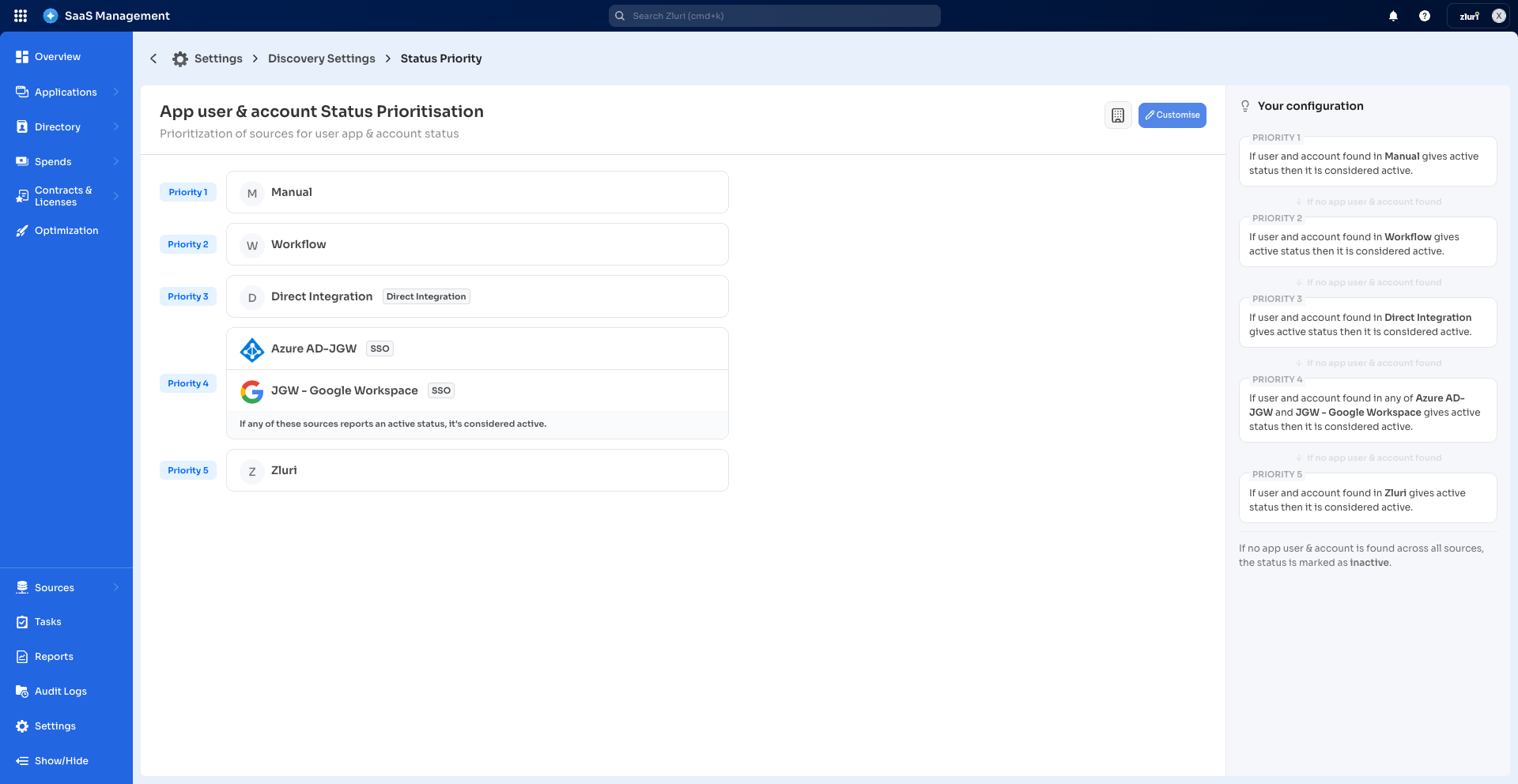
The Your configuration panel on the right translates your priority setup into plain-language rules, for example
- Priority 1: "If application users or accounts found in Manual are in active state, then the application user or account is considered active."
- Priority 2: "If application users or accounts found in Workflow are in active state, then the application user or account is considered active."
- Priority 3: "If application users or accounts found in Direct Integration are in active state, then the application user or account is considered active."
- Priority 4 (grouped): "If application users or accounts found in any of Azure AD-JGW or JGW – Google Workspace are in active state, then the application user or account is considered active."
- Priority 5: "If application users or accounts found in Zluri are in active state, then the application user or account is considered active."
- Fallback: "If application users or accounts are not found across all five
Org-level and app-level settings
The following table explains how the two levels relate to each other.
| Setting | Scope | Takes precedence over |
|---|---|---|
| Org-level source prioritization | All apps in your organization | — |
| App-level source prioritization | One specific app | Org-level default |
When you configure source prioritization for a specific app, that app uses its own configuration and ignores the org-level default. All other apps continue to use the org-level default.
Configure source prioritization at the organization level
Navigate to Settings > Discovery Settings > Status Priority to set the default source prioritization for all apps. Zluri labels this page Application User & Account Status Prioritisation.
App user & account Status Prioritisation page (Settings > Discovery Settings > Status Priority) showing four numbered priority groups: Priority 1 Manual, Priority 2 Workflow and Direct Integration grouped, Priority 3 Azure AD-JGW, Priority 4 Zluri, with the Your configuration panel on the right and Reset to zluri default and Customise buttons at the top right.
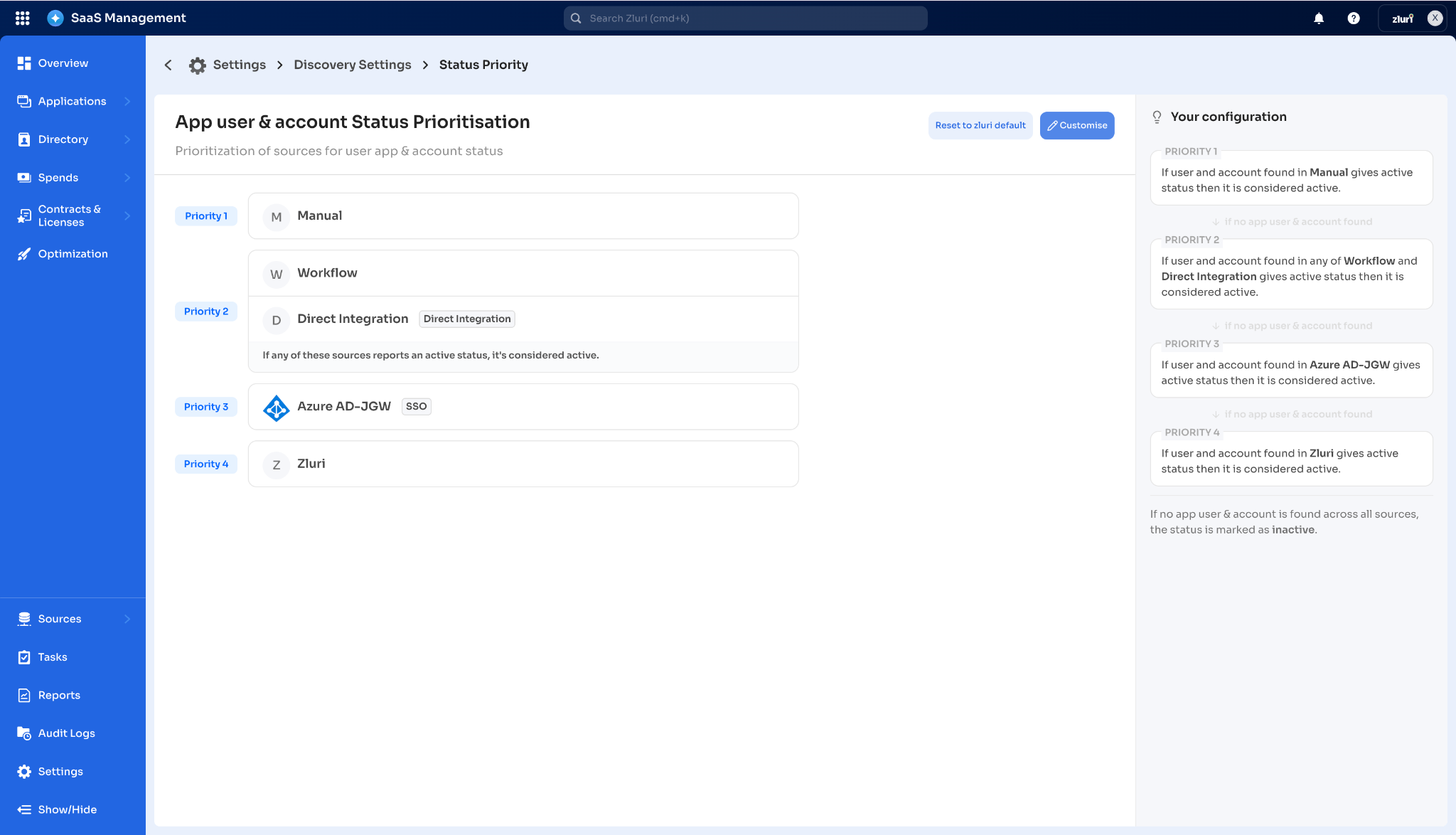
The page displays your current priority configuration, with numbered groups on the left and the Your configuration panel on the right.
Zluri default priority order: Manual > Workflow > Direct > SSO > Zluri
What is Zluri as a source? When a user logs in to the Zluri platform directly, Zluri adds them as an app user. In that case, Zluri itself is the source for that app user.
Steps
- Navigate to Settings > Discovery Settings > Status Priority.
- Select Customise to enter edit mode.
- Arrange sources into priority groups. Place the sources you want Zluri to check first in Priority 1.
- Add or remove sources from each group as needed.
- Select Save.
Select Reset to zluri default to restore the default priority order (Manual > Workflow > Direct > SSO > Zluri).
Configure source prioritization for an app
Override the org-level default with a source priority configuration specific to one application.
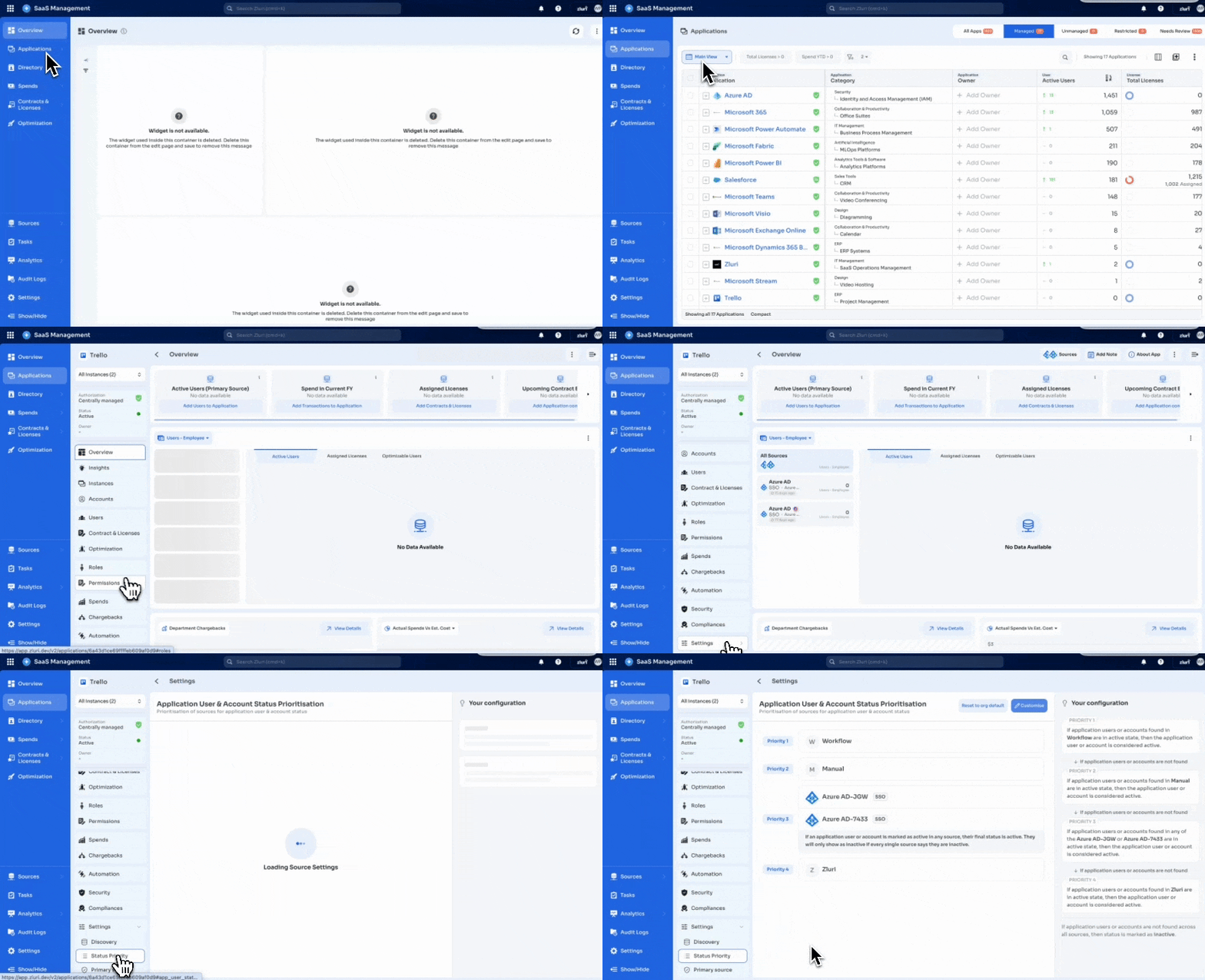
Steps
- Navigate to the app page.
- Select Settings > Status Priority from the sidebar.
- Select Customise to edit the priority groups for this app.
- Arrange sources into priority groups for this app.
- Select Save.
To revert to the org-level default, select Reset to org default.
Source prioritization changes (both org-level and app-level) take 24 to 48 hours to reflect across the platform.
Primary source settings
The primary source is separate from source prioritization. It controls which source drives the Active Users count on an app's overview page. It does not affect how Zluri determines active or inactive status.
Navigate to the app page and select Settings > Primary source from the sidebar.
Set Primary Active User Source page showing a description banner reading “Choose the data source used to calculate active users. This selection determines the active user counts displayed across the platform.” Azure AD-JGW is shown as the selected source with a radio button, and the Set as Primary source button is at the top right
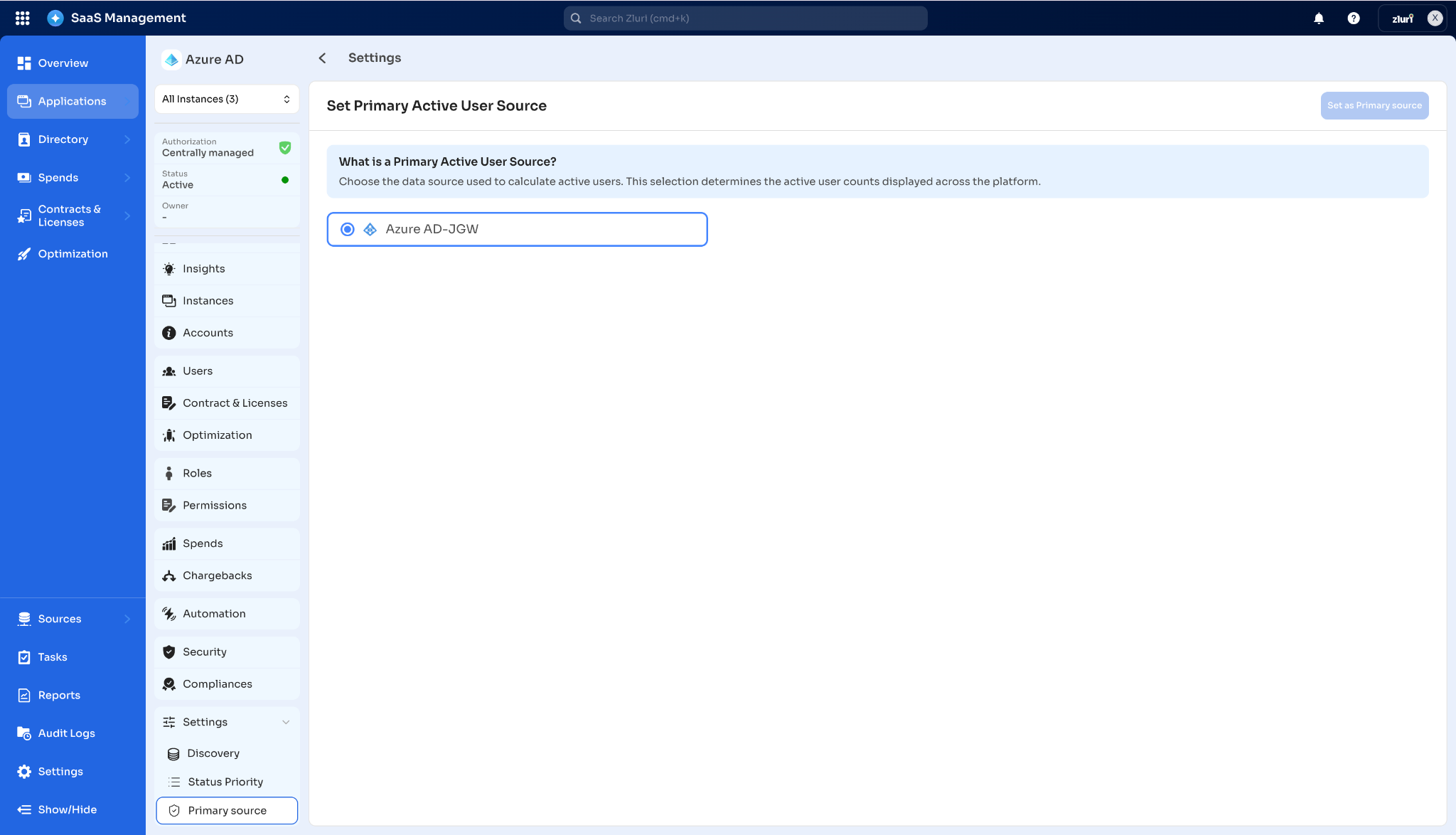
The page shows a list of available integration sources. Select any source to make it the primary. The Set as Primary source button applies the change.
Steps
- Navigate to the app page.
- Select Settings > Primary source from the sidebar.
- Select the source you want to use as the primary active user source.
- Select Set as Primary source.
Select Reset to default to restore the original primary source.
Constraints
The following constraints apply to source prioritization.
- Source prioritization changes take 24 to 48 hours to reflect across the platform.
- Zluri determines account and user status through direct integrations only. Apps connected through SSO, agents, or other methods must also have a direct integration for source prioritization to apply.
Updated 3 months ago